Why do humans invent so many cool things?
What’s so special about walking on two legs?
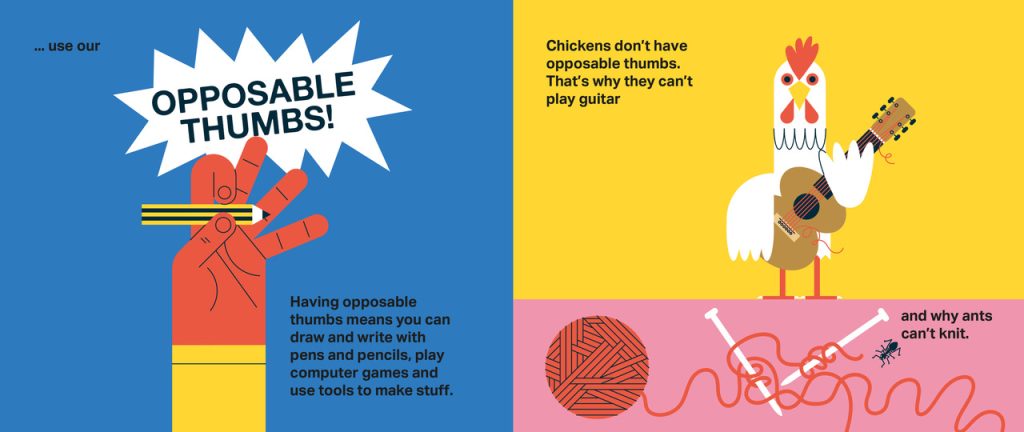
And the big one everyone’s clearly asking: why can’t chickens play guitar?
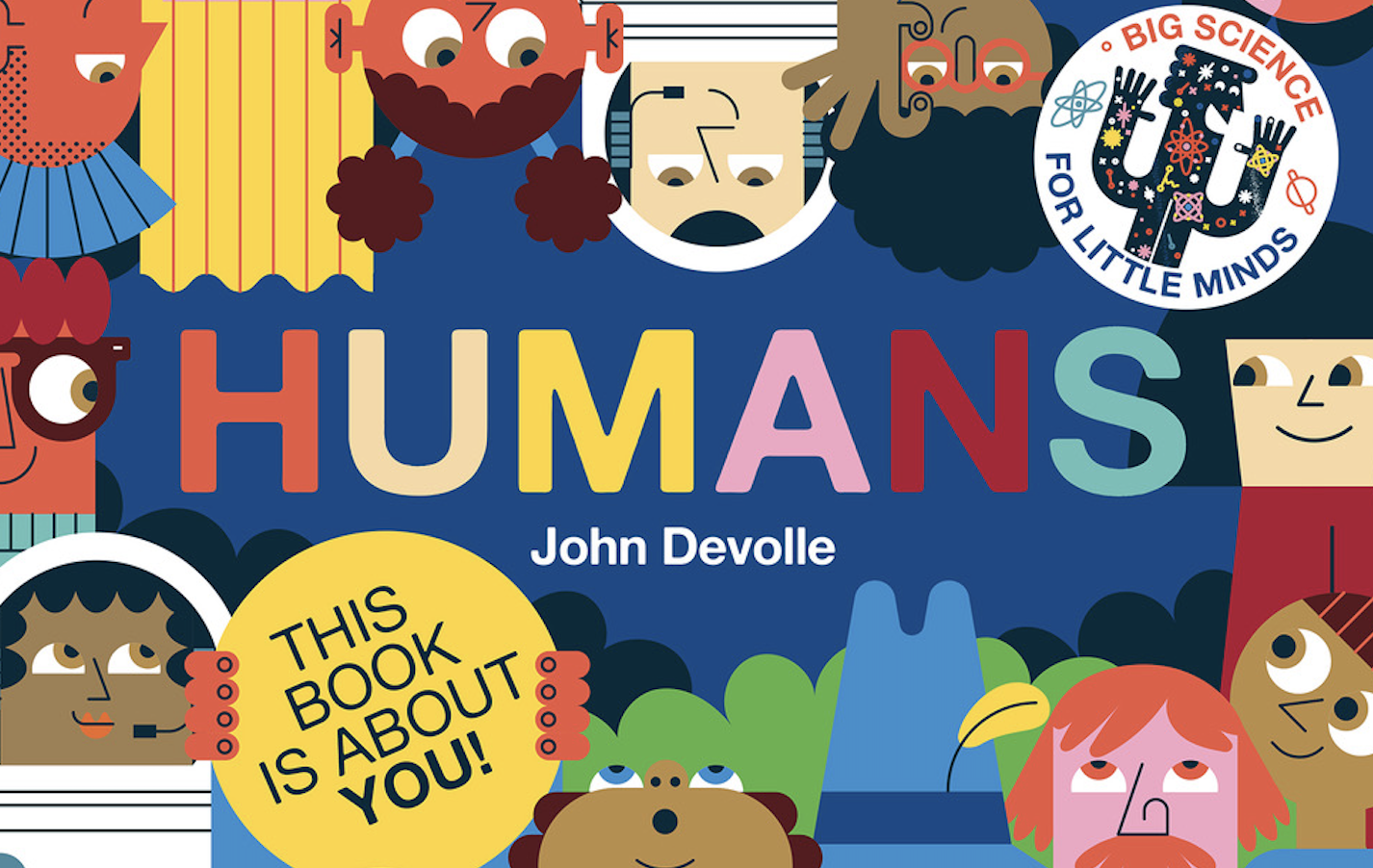
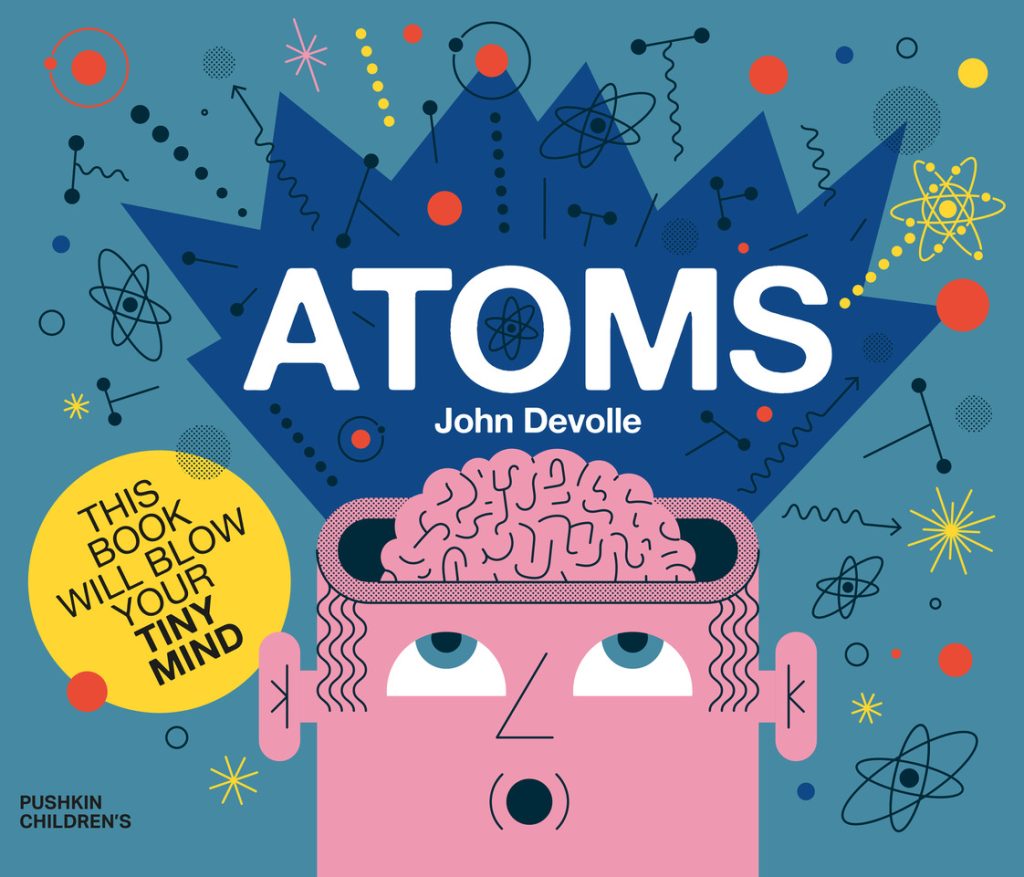
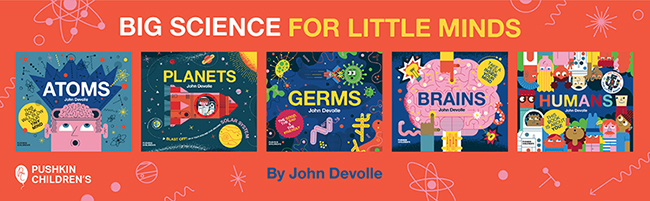
If these questions sound like the start of a chaotic conversation with a very curious six-year-old, that’s exactly the energy behind John Devolle’s hit children’s science series, Big Science for Little Minds, a collection of bright, bold, and wonderfully irreverent picture books that turn huge scientific ideas into joyful, accessible starting points for young thinkers.
Across titles like Atoms, Planets, Germs, Brains, and the newest exploration of human evolution and creativity, Devolle brings science back to its most exciting function: sparking curiosity, wonder and the occasional “WAIT…WHAT?”
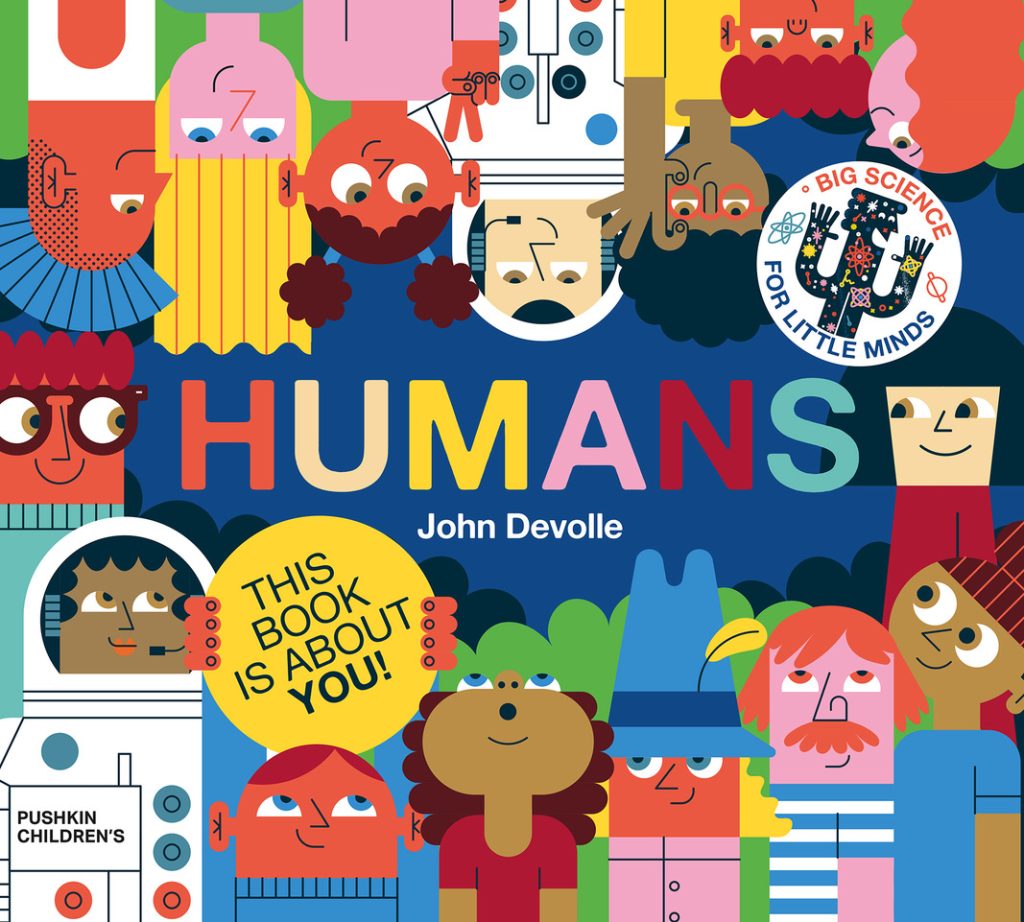
Critics across Children’s Books Ireland, Inis Magazine, Five Books, The Bookseller, and more have praised the series for its stylish illustration, humour, clarity, and rare ability to explain the universe without flattening the fun out of it. Parents love it. Educators love it. Kids extra-super-mega love it.
Science, But Make It Playful
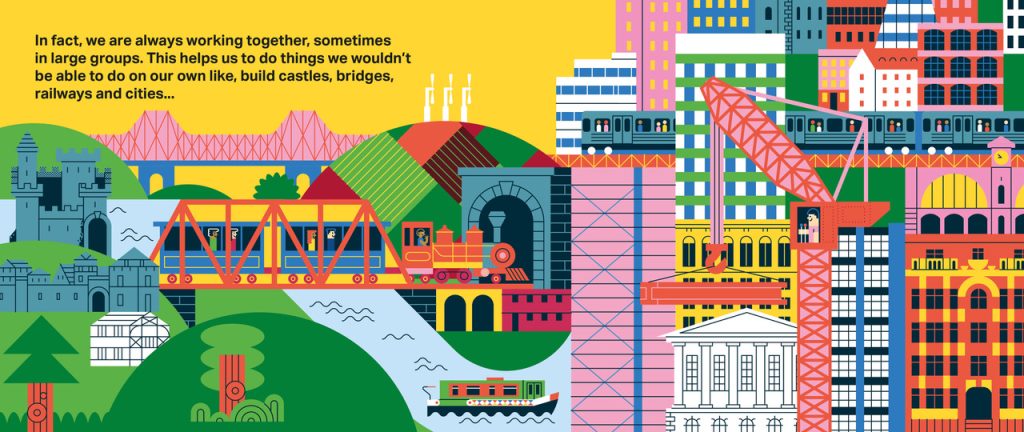
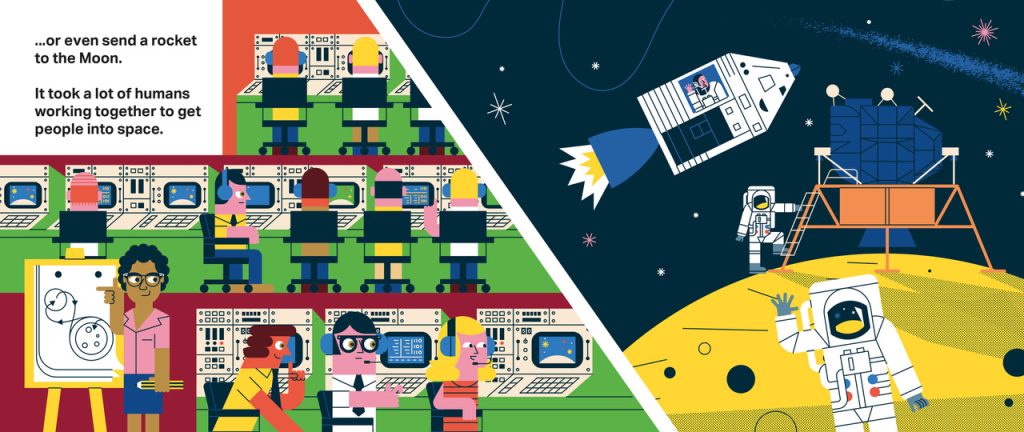
Devolle’s visual language, punchy colours, bold forms, and expressive characters feel instantly iconic and deceptively simple. Behind that simplicity is an illustrator and designer with years of experience distilling complex ideas into striking imagery for scientific institutions, newspapers, and magazines.
What makes his approach stand out is the tone: playful without being patronising, factual without being dry, cosmic without losing touch with the utterly silly. This balance is what turns Big Science for Little Minds into the perfect entry point for young readers who are just beginning to ask how things work… and why.
A few highlights from reviewers:
- “A jumping-off point for curious minds… quirky, stylish and bright illustrations that pop.” — Children’s Books Ireland
- “Conveys scientific concepts in such a colourful and visual way… a joy to read.” — Mini Travellers
- “Bold, colourful and accurate… captures the imagination while educating.” — Five Books
And as if that weren’t enough, the books have been translated into Mandarin, Korean, Polish, and Brazilian Portuguese, proving that the universal language of curiosity travels beautifully.
Inside the Mind Behind the Minds: A Conversation with John Devolle
To dig deeper into the making of the series, the humour, the science, the visual trickery, the happy accidents, and the challenge of explaining atoms to humans who still sometimes forget their own socks, we sat down with John Devolle himself.
Below, he talks candidly about how Big Science for Little Minds came to life, the messy process of simplifying huge ideas, the joys and surprises of working with Pushkin Press, what it’s like to be translated around the world, and why sometimes the best way to draw the Big Bang is simply to write BANG! in the middle of the page.
Read on for our full Q&A with John Devolle…
You’ve said that you “get excited about communicating complex ideas with humour”. How did that philosophy shape the way you approached this series? Were there particular scientific concepts you felt had to be treated differently because the audience is young?
This whole series (of Big Science for Little Minds) came about first because I was reading science books as an adult and was discovering things that blew my mind. This made me think that if I could get some of these ‘mindblowing’ concepts across to young kids, they might have more of an interest in science than I did when I was a kid. I was not a good student at school, and I think part of the problem was how we were taught science in the 1980s. Maybe this was my school in particular or maybe it was just how it was, but as a ‘non academic’ kid I felt I got left behind. So from the very start it was all about getting ideas across to young kids. I think I had learnt the skill of getting across complex ideas in as simple a way as possible from years working on editorial illustrations for newspapers and magazine. I did a lot of work for scientific and engineering publications, where you are often asked to distill a complex idea down into it’s simplest form whilst still making an arresting image. so I think the skills are pretty much the same for both.
The series (including titles like Atoms, Germs, Planets, Brains) is broad in scope. How did you decide which topics to tackle and in what order? Did you map out the entire arc before beginning, or did it evolve organically?
It all started with the original idea I had for the book that became PLANETS. It was more of a narrative originally telling the story of a kid trying to find a better planet to live on because he was sick of his parents telling him what to do. A goldilocks story, as the Earth is known in scientific terms as a ‘goldilocks’ planet because it is just the right size, just the right distance from the Sun, which is just the right size for life to exist. But it never really worked in this form, or at least, my narrative writing skills weren’t up to it. In the meantime, I had another idea for the ATOMS book, which was written in a much more direct, simple way. Hitting the reader with facts and going on a sort of ‘thought journey’, zooming out from a single atom to the whole universe. When I was eventually offered my first book deal through Pushkin Press, they offered me a two-book deal, releasing ATOMS first, and suggesting that I rewrite PLANETS in the same style as ATOMS, and it all fell into place from there. Then we had a series!
What was it like working with Pushkin? How involved were they in shaping the content, tone, illustration style or editing of the series? What were the major benefits (and perhaps surprises) of working with a publisher rather than self-publishing?
Pushkin were great, from the start, they saw the potential in the series. They have generally left me to it, regarding the content of the books. Daniel Seton, my editor, has always been very helpful, giving me advice when needed and feedback along the way, but because I write, illustrate, and design/layout all the books, they are quite hands-off in that regard. They did suggest the subject of the GERMS book, which was their idea, but I felt it was a great idea and fitted in with the series, so I was happy to make that book. The Benefits of working with a publisher were that they are established, they gave me deadlines, as they have distribution and all that stuff already worked out, which leaves me to concentrate on just making the books. Also, I was paid an advance, which meant I could afford to take the time off from client work in order to work on the books. I guess the disadvantage (if there is one) is that the writer/illustrator gets less of a cut of the profits, so I guess if you can afford to take the time and put in your own money to get a book out, you could potentially earn a lot more out of the book’s sales. But for the situation I was in, I think it was the right route to take. Also, I think I needed the ego boost of a company, believing in an idea you’ve had enough to put their time and money into it. And a deadline helps too!
You’ve got a rich background in illustration, design, working with science institutions, education and publishing. How has your experience in those fields helped you when creating children’s science books? Were there any parts of the process that you found unexpectedly difficult or counter‐intuitive?
Because my background is not really in the writing side of things, I found this a challenge. I was used to making simple/fun images, but I had to work at getting the language just right. I was trying to use simple words, but I found that sometimes I would end up with overly complicated sentences. I had to then work on these sections so that hopefully they were as pared down and direct as possible. I think this is probably the case with all picture books, and it is quite a skill in itself.
Translation and global reach seem to be part of the story: “These have been translated into Mandarin, Korean, Polish and Brazilian… so far.” How did translation or international rights considerations affect how you conceived or illustrated the books?
I wasn’t thinking about translating the books at all when I was working on them. I was only really ever thinking about what interested me and following that, all the books came from this, really. We started to get translation deals after the first two books. I was blown away, as it wasn’t really something I had considered. It’s amazing to think that kids all over the world might be reading my books. Especially as I failed my English GCSE 🙂 I am currently working on a very different book for Pushkin, this one is a rhyming book, which would be very hard to translate, but it’s where my interest took me, I pitched it to Pushkin and they offered me a deal to release it, so I’m really happy to be doing it, but if I were doing it with a view to getting translation deals, then I wouldn’t have chosen to do this book.
With science constantly evolving, how do you stay up-to-date and accurate in your content? Did you ever have to revise or rethink a concept because new research or better understanding came along during your process?
So far that hasn’t happened, but I think its because in the books I’m usually dealing with quite established scientific principles, the atomic theory in ATOMS is probably nearly 100 years old, its pretty established stuff that kids and a lot of adults won’t be aware of, so I was trying to get these things across, rather than the cutting edge of science, like string theory of quantum mechanics for example, which is changing constantly as we become more aware of things. So I stay with established principles and try to explore what these mean, for example, the fact that the atoms inside you right now have been part of millions of other things in the past, rocks, animals, trees… stars!
From an illustration standpoint: what part of the visual design process was your favourite? And what was the most challenging piece of illustration or design in the series?
I think my favourite part is when I have an idea, usually for an image with text, in a layout. It’s that combination of things working together that excites me; it could be something really simple, some shapes and colours working well together, for example. One of the most challenging pieces of illustration was drawing the Big Bang, it’s obviously impossible to draw this, so once I realised this and kind of established my approach to drawing this in quite an abstract way, I was OK. Also, I ended up just writing ‘Bang!’ in the middle of it; sometimes, just doing the simple, stupid idea is best.
The series is billed as “Big Science for Little Minds”. Given that, do you have plans to expand into new topics or to adapt the series into other media? What would your dream extension of the series look like?
Yes, I do have plans to do more in the series. I have a couple of ideas for the next ones, and I also would love to produce some short narrated animations of each book, but I’m still looking into how I might do this. In the meantime, I’m busily working on another book, as I mentioned, which is a bit of a departure in style for me; this should be out middle of next year. Not sure I can say what it is yet!

Want to know more about our membership? Give us an email at members@peopleofprint.com.
- Order From Pattern, Disorder From Chance: Sun Möller-Park’s Ready, Set, Fuse – Pt. 2 - October 5, 2026
- Hidden in Plain Sight: Kidnichols and the Making of Mountain Moves - October 5, 2026
- The Quiet Work of Ritual: Garden Party Magazine, Issue 03 - October 5, 2026