
Introduction: From Lists to Legacy
Every designer keeps a stash of secret links. Fonts saved in bookmarks. Mock-ups buried in Google Docs. Inspiration tucked away in endless browser tabs. For most of us, they remain personal survival kits… messy, private archives we use to get through projects.
For Katerina Kerouli, freelance designer, illustrator, and lecturer at Nottingham Trent University, those lists became something more. After ten years of compiling them, she realised they weren’t just useful for her own practice, they could be a resource for everyone.
That realisation grew into Katalog.land: a clean, open, and beautifully designed online directory of creative resources.
“To be honest, I think I absolutely love a good list. I’m a sucker for good lists and I started making these lists as soon as I finished. I think over the past 10 years, I’ve just been meticulously gathering lists online and offline for resources from inspiring books to use software that I have found pretty invaluable to my career so far.”
What started as scattered scraps has quickly become one of the most promising new platforms in design.
About Katerina: A Designer, Lecturer, and Connector
Kerouli graduated from NTU in 2016 and, like many young designers, moved to London. After internships and a stint at Papersmiths in Shoreditch, she joined Laurence King Publishing, working on puzzles, games, and children’s books. A chance encounter with Pentagram partner Angus Hyland led her to join the studio, where she worked across branding and editorial projects.
After COVID, she moved into freelance practice, collaborating with leading studios such as Mother Design, Koto, Accept & Proceed, and DNCO. Alongside her freelance work, she returned to NTU as a part-time lecturer, helping final-year students with projects and portfolios.
It was in this role as mentor and tutor that the real need for Katalog surfaced.
“I would always be referring to these lists that I had on the side or my Google Docs or my favourite tabs or whatever it was to students when they were after a particular typeface. Oh, have you seen this typeface on this type foundry? Or oh, there’s some really good mockups on this web page. And I’d have to go through all my lists again and I’d think, oh, it’d be so good just to have this one all one page and I could just give this page to them or I could just have it as a reference”

Why Katalog Exists
Katalog.land solves a problem every designer knows: the scatter and inaccessibility of knowledge. Existing directories are often bloated, uninspiring, or hidden behind paywalls. Blog listicles come and go. Students, especially, struggle to find starting points.
“It’s so important not to gatekeep in this creative community…and really share and have an open source library of all these resources.”
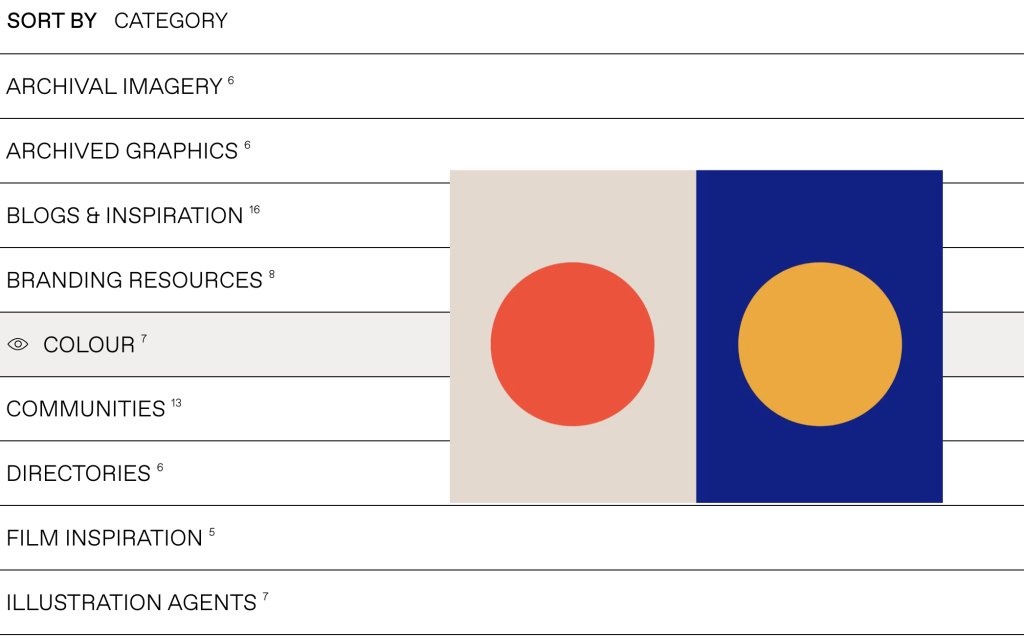
The platform takes a different approach: a curated, hand-picked set of resources that are visual, memorable, and open.
Design Decisions: Simplicity, Imagery, and Lucky Dip
Katalog’s design reflects Kerouli’s belief that form is just as important as function.
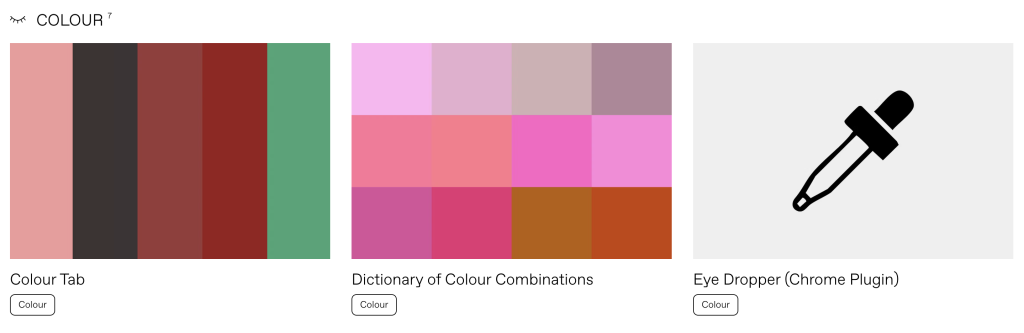
“None of the other resource websites had images. And we are visual people, at the end of the day we read an image to remember, oh, that link is that. I remember that. Or almost entice you to click on it. Some, some websites I noticed had logos, but they’re all very black and white. I think with images with a lot of colour, I think that’s what makes it a bit more interesting.”
Every listing in Katalog is visual, not just text. This makes it instantly more engaging and intuitive. Another key feature is Lucky Dip.
“The Lucky Dip is that you might not be looking for something specific, but it will lead you to an unknown website and you don’t know what you might discover. And it could lead to something really nice or a nice concept for a project…that’s the whole idea behind Lucky Dip. And it was essential for me to add that in somewhere.”
It’s a reminder that discovery is as much about chance as it is about search.
Building Katalog: From Passion Project to Platform
The first version of Katalog was a simple page on Kerouli’s personal site. She pitched the concept to NTU, received a small pot of funding, and then decided to self-fund the rest. She brought on developer Jason Booth to build the site, and together they designed a platform with categories, filters, and a clear, functional interface.
The name, like the project itself, came quickly and naturally.
“I was hanging out with these friends after New Year’s in January and I was like, oh, I’ve got this little idea that it’s like a library of design resource. I’m just not really sure what to call it. I wanted something witty and within not even a minute I was all about Katalog and that was it.”
For a passion project, the execution is remarkably polished.
What’s Next for Katalog
Although still in its infancy, Katalog is already gathering momentum. Kerouli updates it weekly, pulling from the same notes and habits she’s developed over years.
“Every week, anything that I think of, I just stick it on there and the end of every week I’ll add it on to Katalog. It’s version one for now and I’m sure, yeah, ideally I’d love a little submissions button where you can submit your own website. You can submit a website that you absolutely love and then I review it as well.”
Future plans include:
– Global reach: filtering by country and region so resources aren’t UK-centric.
– Submissions: allowing users to propose sites and tools, with editorial review.
– Talks and events: curating live conversations and networking for graduates and professionals.
– Publishing: exploring books or zines that capture curated categories.
“It will be really nice to curate a series of talks from different parts of the industry that are featured on Katalog or some sort of networking event for young creatives or fresh graduates.”
“I’d definitely make them to a book. Definitely. The only thing with that is you know things change so fast. I’ve noticed that you know there’s so many things popping up and websites can’t see changing that by the time you’ve made the book things have changed.”
For now, it remains a passion project, self-funded and open.
“It’s a work in progress at the moment and I feel with these side passion projects it’s so important just put them out, see what happens and keep working on them because you can work on them for years and years and never put it out. So that’s why I’ve just put it out now.”
Why People of Print Likes Katalog
At People of Print, we know the value of directories. Our own platform started life as a simple list of printers and studios before growing into the global community it is today. When we look at Katalog.land, we see the same spirit: clear, generous, and filled with potential.
We like it for three reasons:
1. It’s designed with care, a resource that is actually enjoyable to use.
2. It’s built on generosity, no gatekeeping, just knowledge shared openly.
3. It’s future-facing, a foundation that can grow into global filters, events, and even publications.
As Kerouli says:
“Connecting people is the most important part of our industry. You never know where a single click might lead—maybe a new typeface, maybe a new idea, maybe even a career shift.”
That’s why we believe Katalog.land isn’t just a handy tool for students, it’s a platform that could evolve into a cornerstone of the design ecosystem.

marcroy@peopleofprint.com
- The Virgil Reader Vol. 001: Virgil Abloh’s Legacy as an Open-Source Tool - March 10, 2026
- City Series #002: Amesbury, Massachusetts with Carl Unger of Harsh Realm and Monotype - March 9, 2026
- How Creatives Shut Off From Work - March 4, 2026