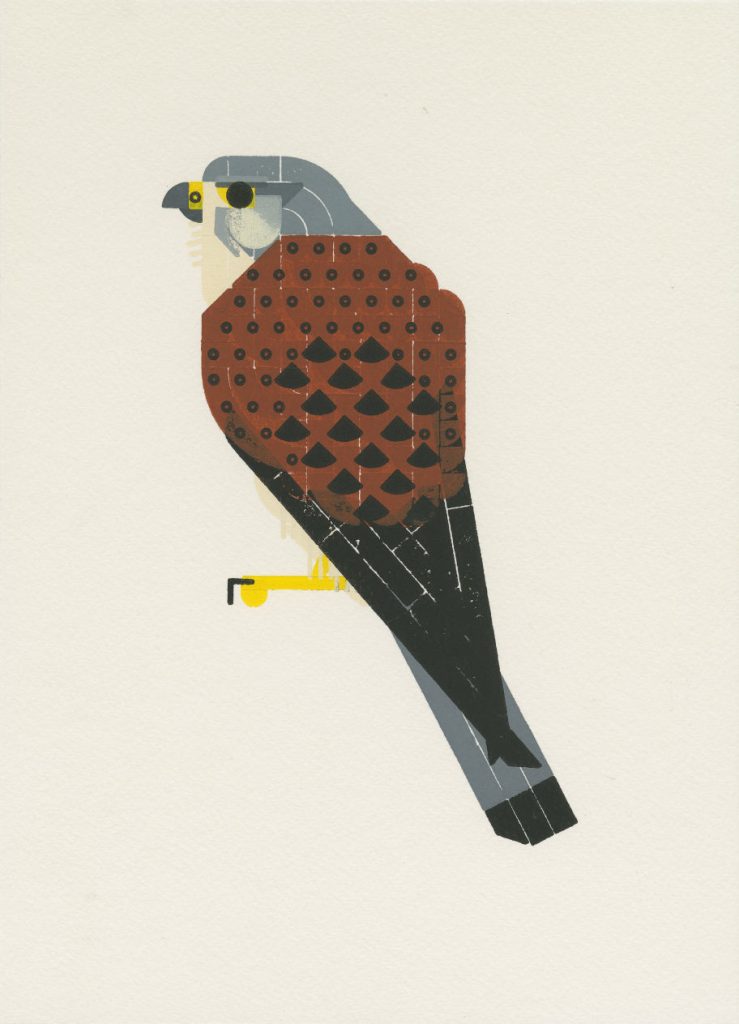
Few artists have taken the humble LEGO brick and transformed it into a medium of fine printmaking quite like Roy Scholten. Known for his innovative LEGO letterpress technique and his long-running 50 Birds series, Roy continues to blur the line between play, precision, and print. His latest work, The Common Kestrel, captures the fierce beauty and aerodynamic grace of one of the Netherlands’ most familiar birds of prey, the Falco tinnunculus.
For Roy, this isn’t just another addition to his avian portfolio; it’s a deeply personal project. The Kestrel has been a favourite since childhood, “that fierce, built-in scowl, the mighty yellow talons, that armour-like patch around the nostril,” he recalls. Declared the Dutch Bird of the Year 2025, the species becomes both muse and metaphor: a symbol of focus, balance, and patience, much like Roy’s own meticulous printing process.
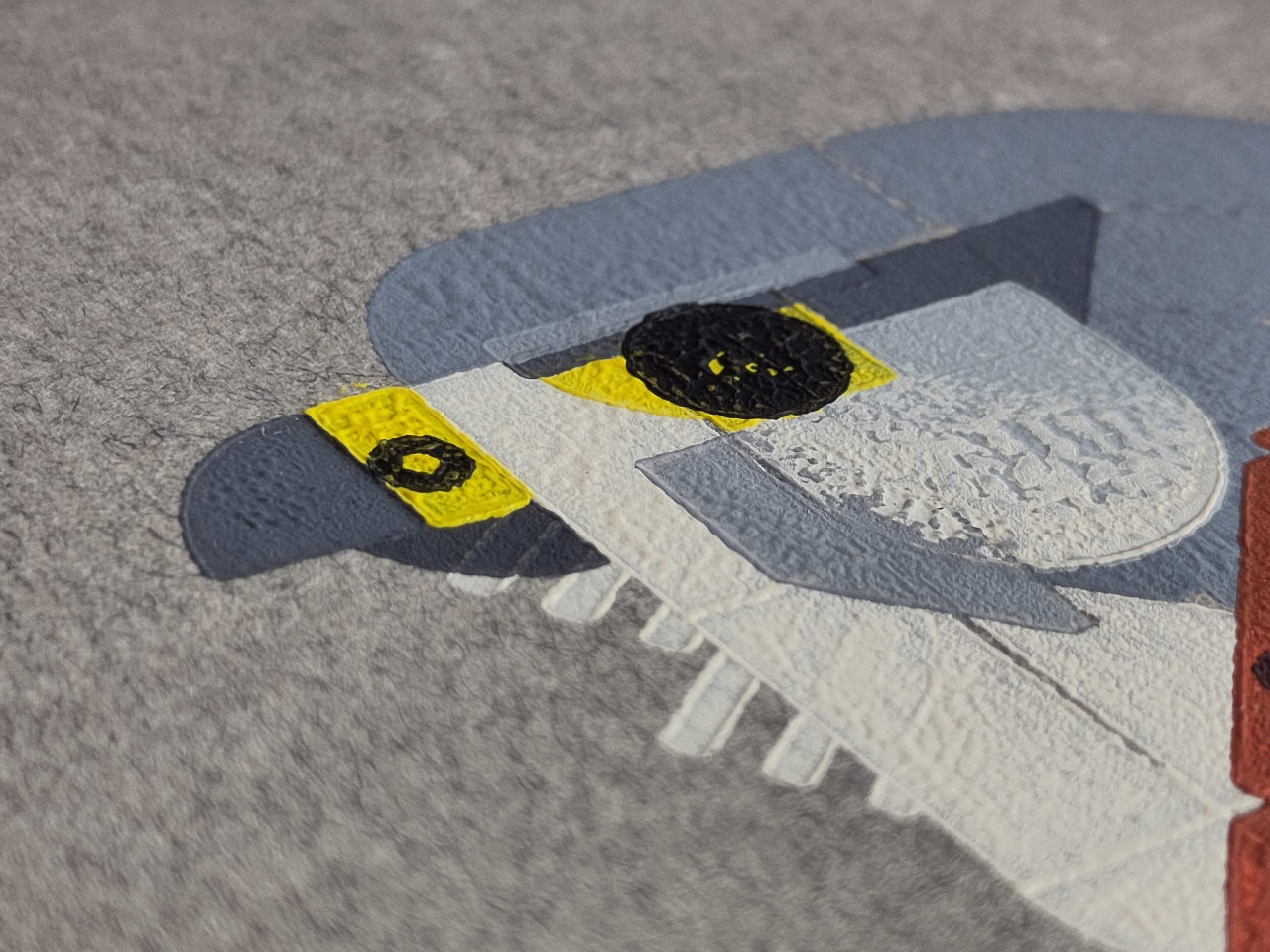
Created through eleven separate formes and passes through the press, this piece showcases the evolution of Roy’s craft, from the angular geometry of LEGO tiles to the dynamic posture of a hovering raptor. The larger format demanded new compositional thinking, where every wing angle, tail slant, and pattern had to find equilibrium. The result is a print that feels alive with motion, texture, and respect for the subject.
But The Common Kestrel isn’t just a technical triumph; it’s also a gesture of care. Ten percent of proceeds from the edition go to Sovon, the Dutch knowledge centre for bird research, a fitting tribute to the living creatures that inspire his work.
This autumn, Roy’s bird prints will take flight across the UK, with exhibitions at Mall Galleries (London), Bankside Gallery, and Tŷ Pawb (Wrexham). A testament to how his singular approach to printmaking continues to resonate internationally.
We caught up with Roy to talk about his fascination with birds of prey, the patience behind eleven printing passes, and how each LEGO brick becomes part of a much bigger picture
You’ve described birds of prey as lifelong favourites… what is it about the Common Kestrel in particular that drew you to finally make it the subject of a LEGO letterpress print? Was there a specific moment or image that inspired this design?
I have a distinct memory of going on a birding walk as a boy and seeing a Common Kestrel up close for the first time. It was sitting on a pole, sternly staring ahead. It was an impressive sight.
You mention experimenting with angles beyond the usual 0°, 45°, and 90° in your recent prints. How did that technical innovation change the way you approached this piece, and what challenges did it bring when translating a bird’s complex posture into modular LEGO shapes?
These extra possibilities quickly proved useful in designing this Kestrel. It was essential for designing the wings that end at a pointy slant, and for the tail that needed to be angled just right to get a balanced pose. Balance is key. There are many different ways I could have created the overall shape and posture, but only a few result in a convincing stance.
This print took eleven separate formes and passes through the press, quite a feat of registration and planning. Can you walk us through how you keep control (and your sanity!) when managing such a multi-layered, hand-built process?
I won’t claim I kept my sanity, but the number of formes increases gradually as I’m refining the design. I don’t start out with eleven blank canvases to stare at, so to speak. The eleven formes are a natural outcome of the process. The order of printing is marked on the plates by a dot put onto the first, second, third, etc., nub on the plate. It can get frustrating though! Especially when you need to fine-tune an element in step nine, which requires all the previous steps to be printed first, only to find out that it’s not quite right. Rinse, repeat…

Moving from your 50 Birds series to a larger format meant working at a different “resolution”, as you put it. How did that shift in scale affect your design language? Did you find yourself simplifying or amplifying detail in unexpected ways?
One interesting shift has been that working on this scale allows for designing actual patterns instead of only suggesting them. In the low resolution of 16×16, I could only hint at the small specks, stripes, or patterns in a bird’s markings. So it was a delight to work on the markings on the back of this Common Kestrel. Hence, printing that part of the overall design as a separate print as well.
You’re donating part of the proceeds from this edition to Sovon, supporting bird research in the Netherlands. How important is it for you that your prints connect back to the real birds and conservation work they depict? Does that sense of purpose feed into your creative process?
It’s a relatively new aspect of my work, but I do feel it is important. We live in a multi-species world. A multi-species world is the only one that works. It’s very gratifying to see people enjoy my prints of birds. But I make those prints because I am in awe of the richness and variety of the actual living ones. They bring so much joy to so many people all over the world. In my very small way, I want to support the work to preserve that. It’s their planet too.
About the Print and Process…
Falco Tinnunculus / Common Kestrel / Turmfalke / Faucon crécerelle
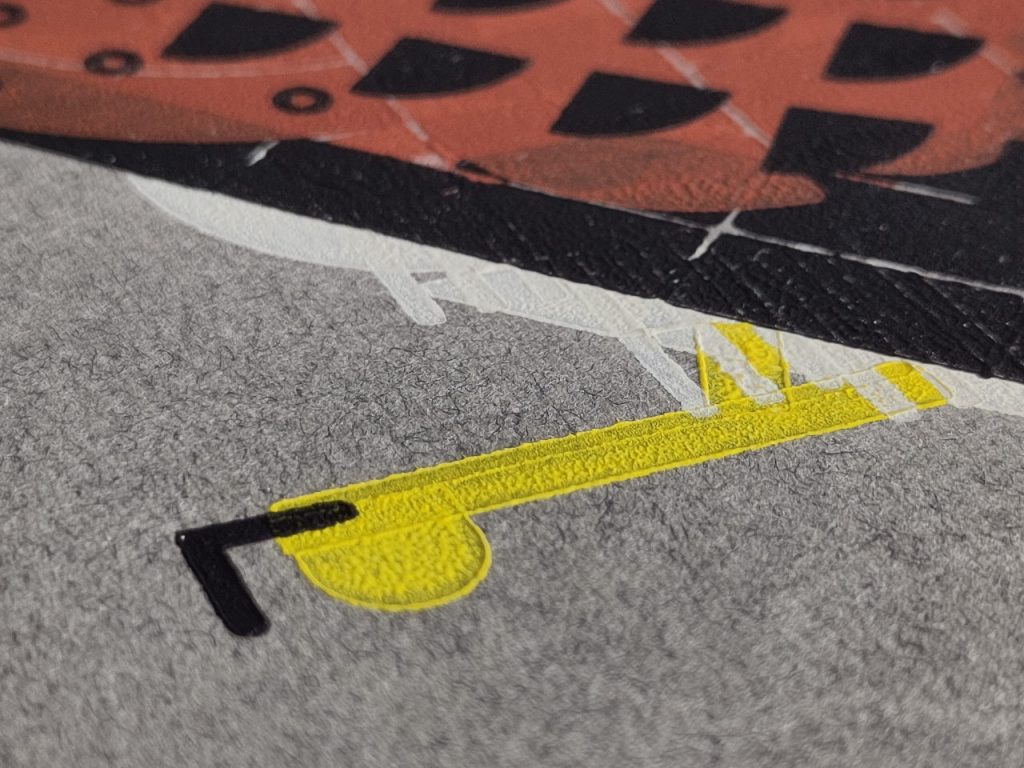
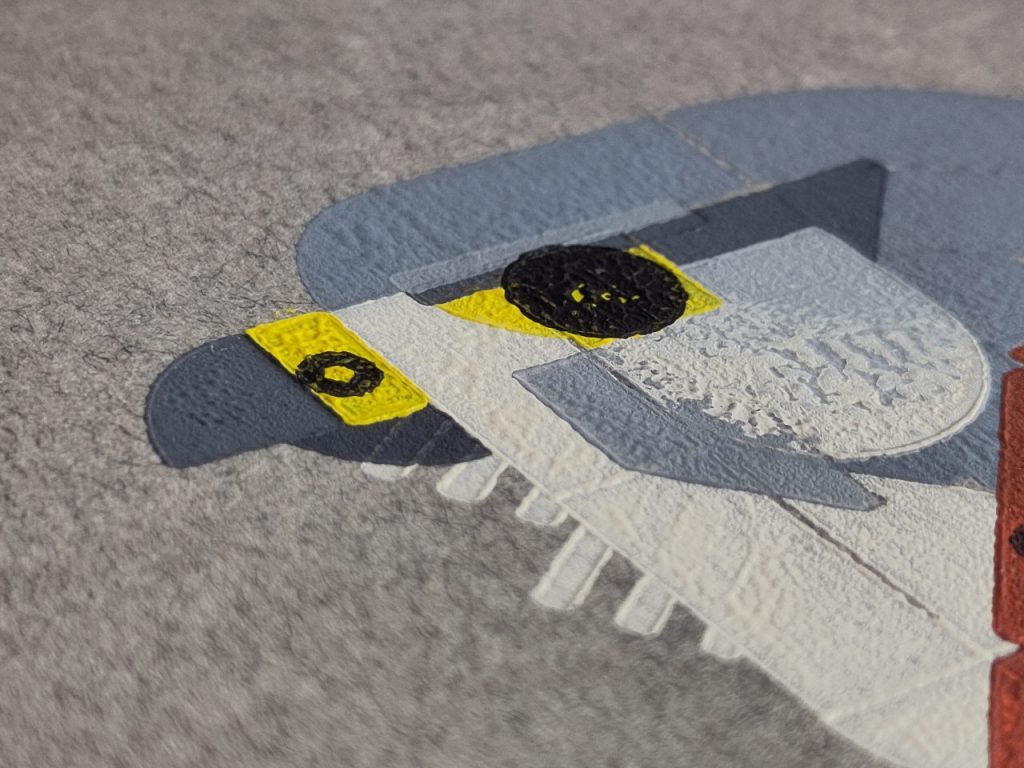
Birds of prey have been Roy’s favourite birds since childhood. That fierce, built-in scowl, the mighty, bright yellow talons, that almost armor-like yellow patch around the nostril. And just imagine their view on things. High in the sky, slowly circling and gliding on wings of, important fact, a certain wingspan.
And so, prints of birds of prey in LEGO letterpress had been on the wish list for some time already.
As a mouse-eater par excellence, its hunting method is its hallmark: some ten or fifteen meters above the ground, hovering in the air at a fixed position (in Dutch: praying), scanning for prey.
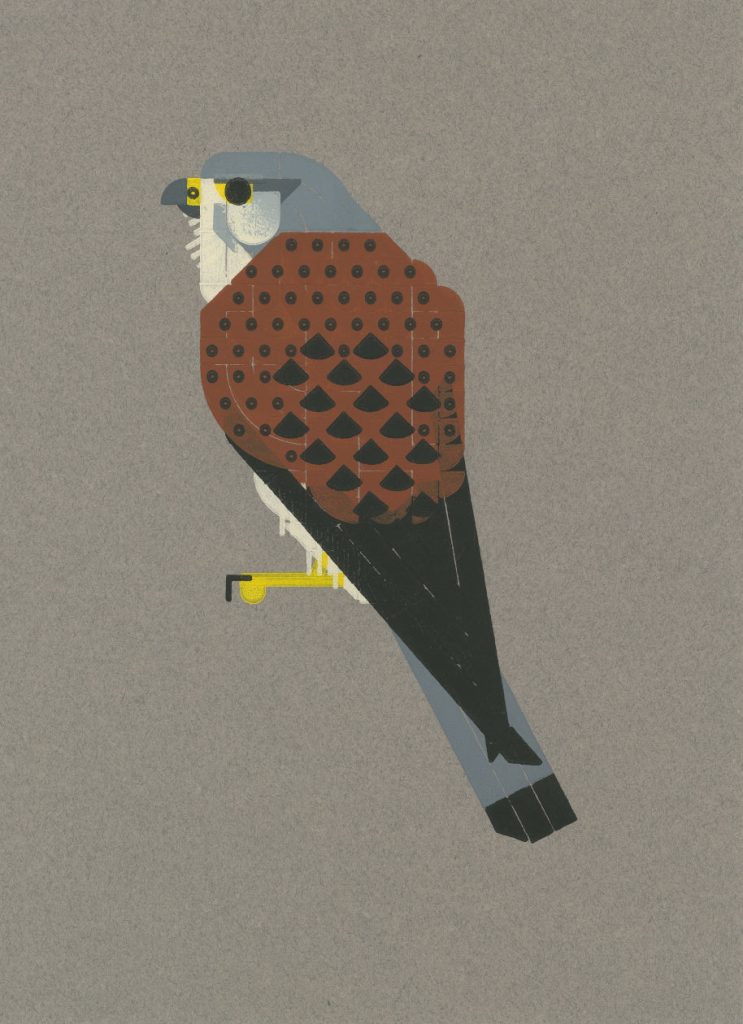
As characteristic as this hovering may be, this was not the pose Roy chose to depict the kestrel in. The wings are at odd angles, seen from a very foreshortened perspective, and with the less intensely coloured undersides visible. Difficult. Much better to show it in such a way that highlights the pattern of black spots on the male’s back. (The female is really beautiful too!)
The motif for those black spots turned into a printing form that itself yielded an interesting graphic image.
Design notes
In the last few prints of 50 birds, Roy had found a way to position elements at angles other than 0, 45, or 90 degrees. These extra possibilities quickly proved useful in designing this Kestrel. For the wings that end at a pointy slant, and the tail that needed to be angled differently for a balanced pose.
The larger dimensions, combined with those unusual angles, made the design process considerably more complex. Finding the right shapes and fine-tuning their proportions required numerous test prints. Even these initial test prints for the overall shape quickly required multiple printing plates. Because, as always, where shapes overlap, they can’t be printed simultaneously.
Bigger sizes also offer more room for detail. But those spaces weren’t necessarily easy to fill. The way Roy could stylize the designs in 50 Birds didn’t transfer directly to this larger format. Clearly, a matter of working at a different resolution.
The Common Kestrel print
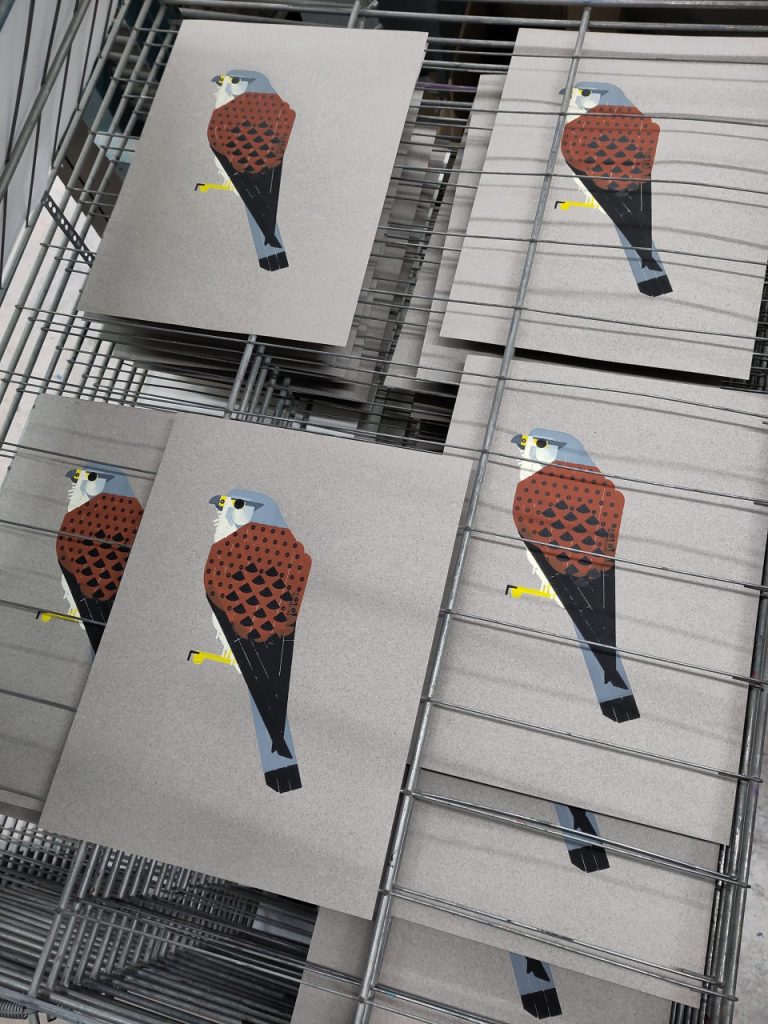
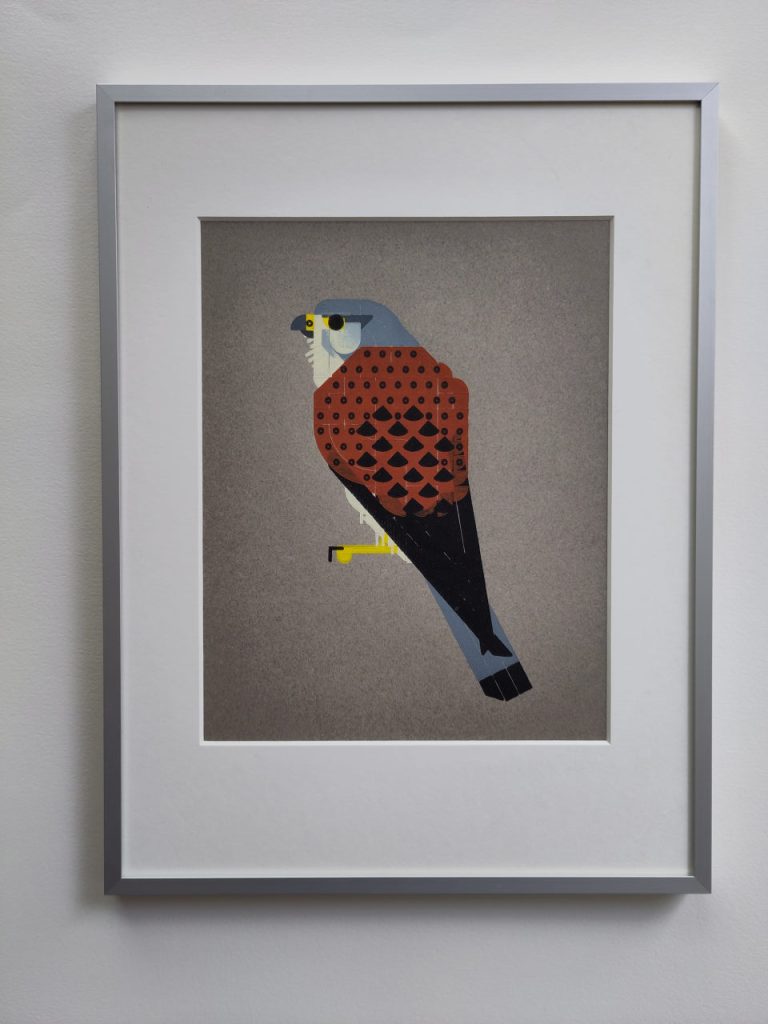
The print was made using eleven separate printing formes. Eleven passes through the press to create the finished image. The dimensions are 30.5 by 23 centimeters.
There are two editions:
- 30 copies on white, 638 grams(!) Saunders Waterford paper
- 25 copies on warm gray, 160 gram Canson Mi-Teintes paper
Buy a print, support the research
Roy will donate ten percent of the proceeds from selling this print to Sovon, the knowledge center on Dutch bird species, to support their important research. Read more about that here.
See the Common Kestrel print at these upcoming exhibitions in the UK
A selection of Roy’s bird prints will be on show at three exhibitions in the UK over the next few months.
The Natural Eye
This annual exhibition of the Society of Wildlife Artists showcases the very best of fine art inspired by the natural world. Bluethroat and Common Kestrel will be shown in the Mall Galleries in central London. The exhibition runs 16 Oct – 25 Oct 2025, open every day from 10am to 5pm.
International Original Print Exhibition
Established by the Royal Society of Painter-Printmakers, celebrating the best in all types of contemporary printmaking. The Common Kestrel and Bluethroat prints are part of this group exhibition in the Bankside Gallery. On show November 6 to 16, 2025.
Print International
A selection of prints, including the Kingfisher and the Chinese Crane will be part of the Printing in Dutch selection in the Print International exhibition at Tŷ Pawb in Wrexham, Wales. November 11 2025 to January 24, 2026. The Printing in Dutch section of the exhibition will then be shown at other venues in England, dates to be announced.

Want to know more about our membership? Give us an email at members@peopleofprint.com.