Welcome back to our City Series, a collection of conversations exploring creative lives through the places that shape them.
For our second instalment, we travel across the Atlantic to Amesbury, Massachusetts, a historic New England mill town where brick factories, independent record stores and artist studios sit side by side. It’s here that Carl Unger balances two creative worlds: his role as Content Lead at Monotype and his evening practice in a shared studio overlooking the river.
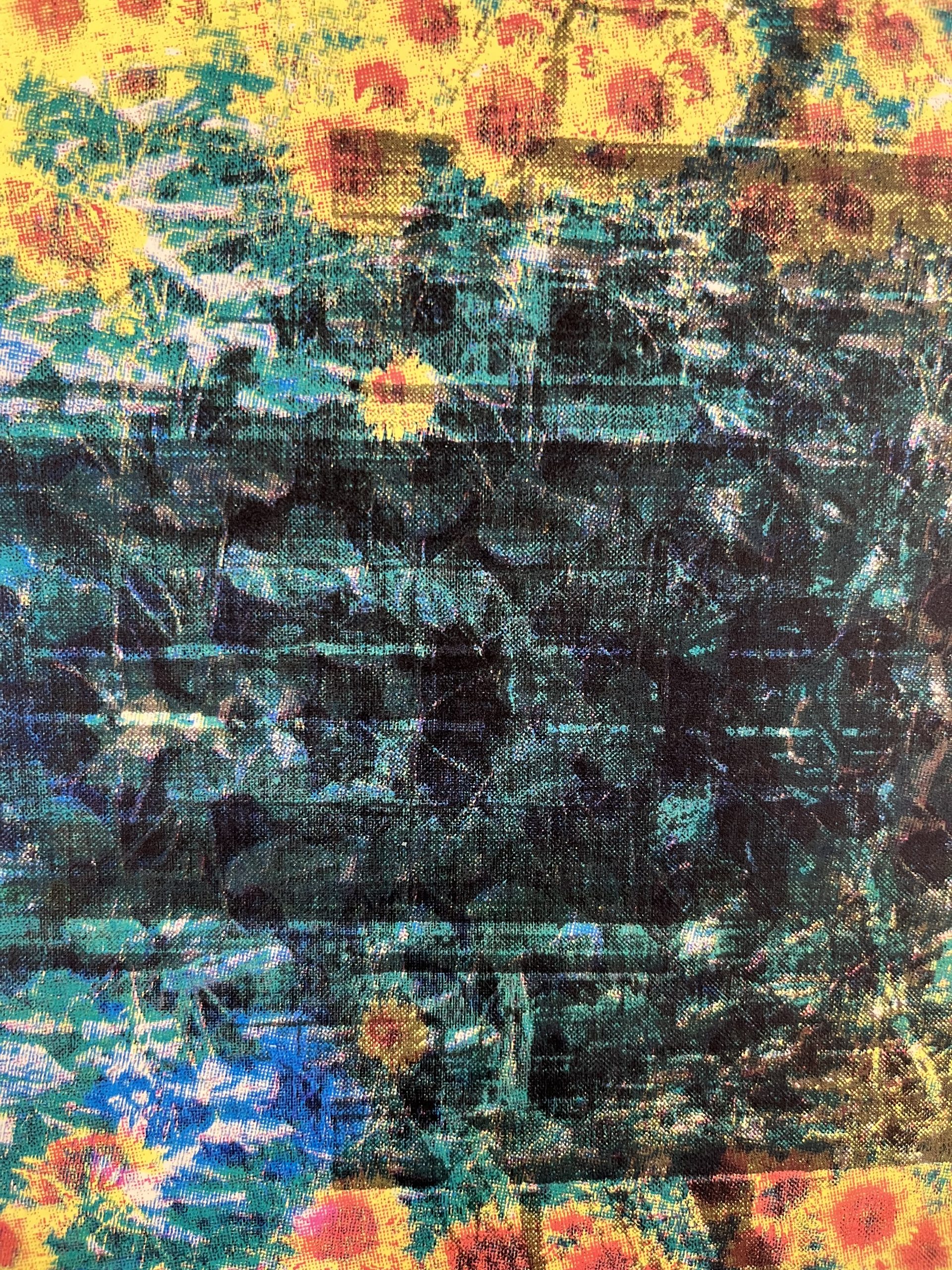
Carl’s work sits somewhere between typography, music culture and personal reflection. Influenced by punk and indie scenes, early alternative rock and the graphic traditions that grew alongside them, his prints channel a certain atmosphere, equal parts melancholy, humour and stubborn optimism. Harsh Realm itself takes its name from a famous 1990s grunge-era prank on the New York Times, a fitting origin for a practice that enjoys poking gently at authority and nostalgia alike.
But this conversation is not only about screen printing. It’s about the texture of a place and how creative life grows within it. Amesbury is a town shaped by its industrial past: towering brick mills now filled with studios, walkable streets lined with breweries and cafés, and a vibrant creative community.
In this interview, we talk about architecture, record stores, community events, the influence of music subcultures, and the push and pull between corporate creative work and independent analogue practice.
For Carl, printmaking is both refuge and experiment: a place to question nostalgia, examine memory and translate those tensions into ink on paper.
For readers discovering you for the first time, who are you in your own words, and what does your day-to-day life actually look like?
I should have my teenager write this section, just to see what he comes up with.
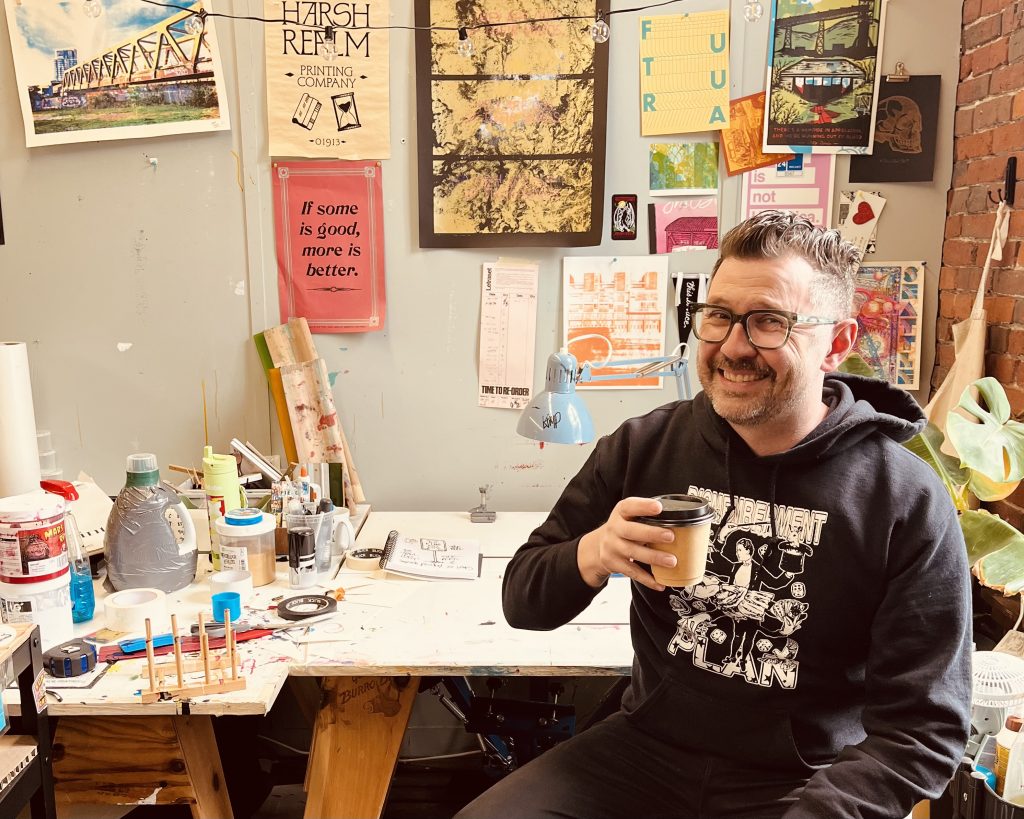
I am a screen printer based in Amesbury, Massachusetts, which sits near the ocean in the northeastern corner of our state. I live with my aforementioned teenage son, my partner, Margaret, and three cats. I currently work as the Content Lead for Monotype.
My studio is a business in the loosest possible sense of the word. I share it with Margaret, who accounts for approximately 80% of our combined artistic ability. I’m usually in the studio in the evening, maybe 3-4 days a week, depending on the time of year and whether I have any good ideas at the moment.
Shameless self-promotion:
Follow me at www.instagram.com/harshrealm_printingco/ and Margaret at www.instagram.com/feeddogproductions.


You work at Monotype and also run Harsh Realm Printing Co. How do those two roles sit next to each other in your life, and what does each one give you creatively?
You never know, but I don’t think I would have a print studio if not for my time at Monotype. It’s been like a backstage pass to the world of typography and graphic design, illustration, printmaking, and so forth. I’ve gotten to meet and interview some pretty amazing creatives through our podcast, and each day I get to work with legendary type designers like Sara Soskolne and Charles Nix (who would probably hate to hear me describe them as “legendary”).
All that said, it’s still a desk job with many of the trappings you’ll find at any typical corporate workplace. My studio is a refuge from those less glamorous aspects of the job. But all the exposure and relationships I’ve built through Monotype gave me both the confidence and guidance to pursue screenprinting seriously.
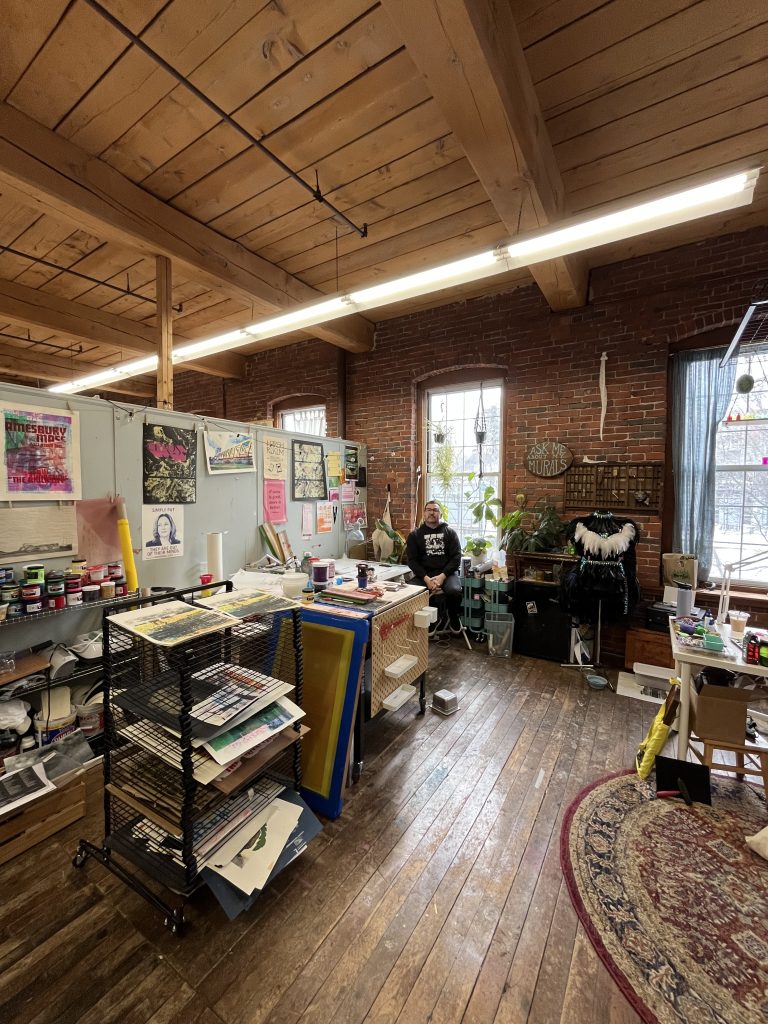

Where are you based right now and how would you describe the personality of that place to someone who has never visited?
Amesbury is one of many old mill towns in New England. The downtown architecture is dominated by several immense brick buildings, most of which are now apartments, offices, or art studios — including ours — and everything from the downtown layout to the river running through it is influenced by the city’s history. I love Amesbury because it’s welcoming and vibrant but not overly gentrified (yet). And it’s walkable! I can walk from my house to my studio, a coffee shop, brewery, record store, Thai restaurant, you name it
What kind of creative culture surrounds you locally? Is it loud and visible, or quiet and underground?
A little bit of both. Amesbury has a large population of artists, but most of them work quietly during the year until our annual Open Studios weekend every November (which Margaret helps run). Open Studios brings out thousands of people — our studio space is always packed.
It seems like the energy is picking up lately, however. A new arts education space launched last year, some murals went up, a new pottery studio opened, and there’s a growing sense of Amesbury as a community defined by its artists. It’s really exciting!
When you leave your workspace, what does the street look like? What do people wear? What music do you hear? What feels distinctly local?
First of all, Mel’s Record Store is right across the street from me, so that’s a problem. I am a middle-aged dad/former indie kid, so you know I have a record player.
A lot of people move up here from Boston because Amesbury has the vibe of a city neighbourhood. Our downtown wouldn’t feel out of place in Hackney either, or maybe Camden. So you’ve got young families out for a walk, skater kids being noisy, people remote-working in coffee shops, anti-Trump protests most Saturdays, one very grumpy florist — it’s a real menagerie.
How would you describe the fashion and visual culture around you? Does it influence your print work consciously or subconsciously?
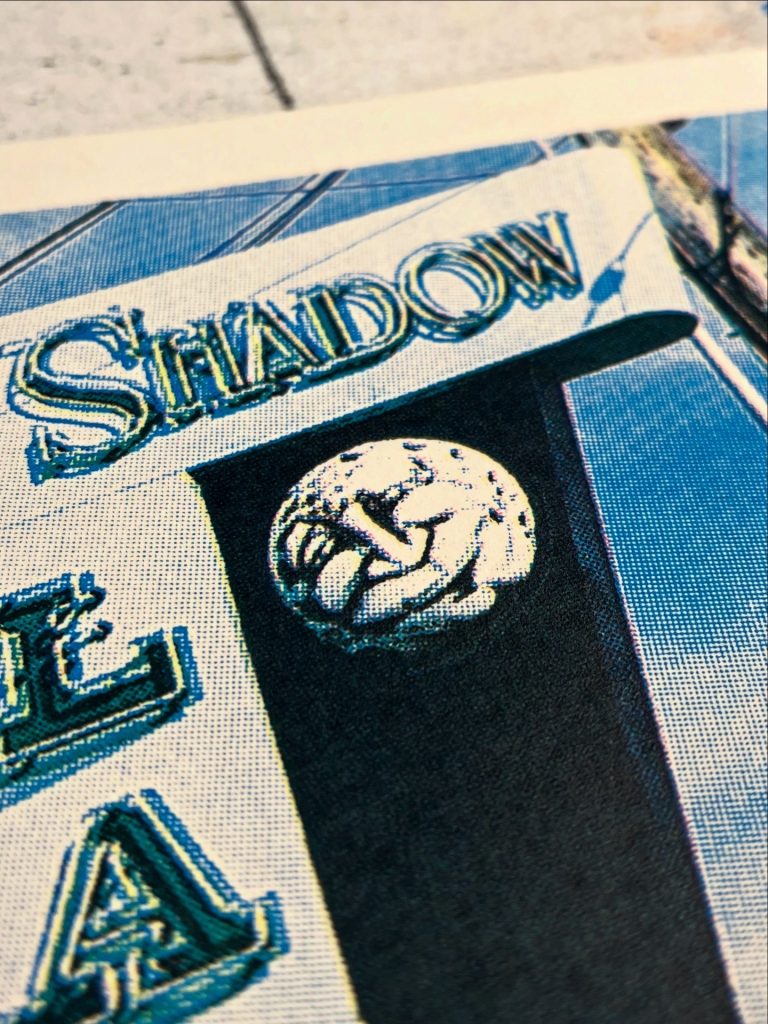
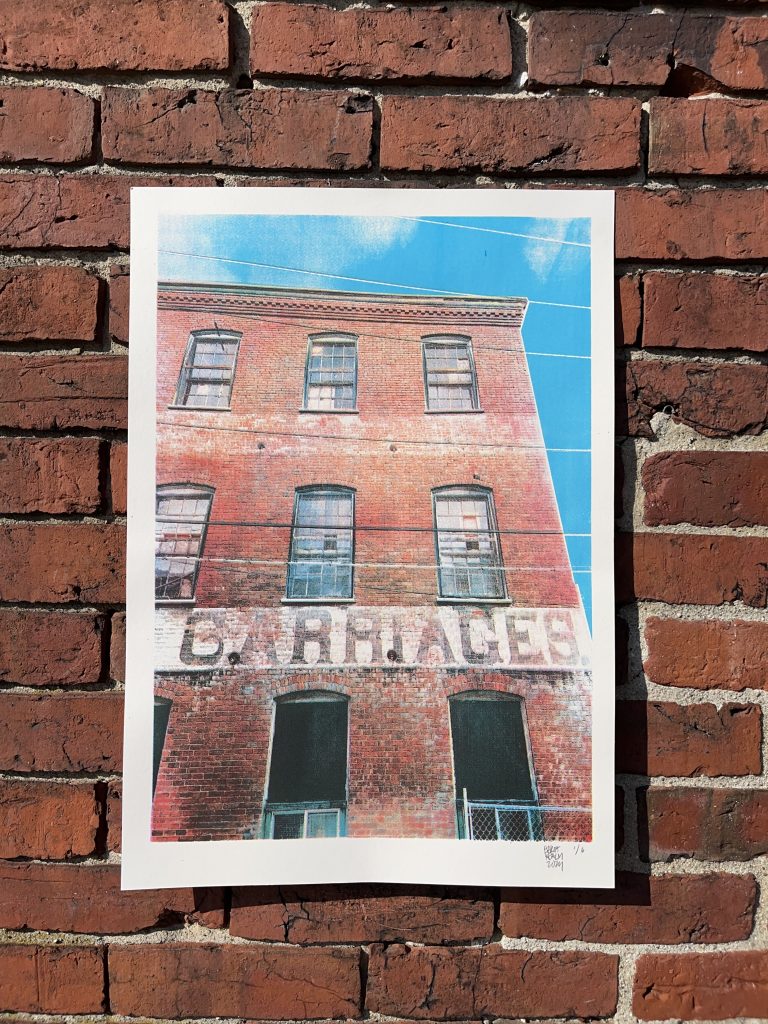
The architecture is both an influence on my work and the subject matter of several pieces. Amesbury has character. It hasn’t glossed over its scars or turned itself into a museum. Even buildings that were redeveloped have maintained their rough edges, so the city is full of texture and angles and contrast. On a clear summer day, the contrast of sunlit brick against the bright blue sky feels unreal. The city always feels fresh to me.

Where do you go to feel inspired outside of design? A gallery, a dive bar, a skate spot, a record store, a bookshop?
I feel like I should work for the local tourism board because we’ve really got everything here. The ocean is 15-20 minutes away, and we’re close to small cities like Portsmouth, New Hampshire and larger ones like Boston and Portland, Maine. I could sit by the ocean all day in all seasons, watching the landscape and light change, but I also love cityscapes.
I lived in Central Square in Cambridge for a few years and still love going back. There are lots of public art, different cuisines, some divey bars and questionable businesses, and a great Asian grocery store. Another place that hasn’t fully succumbed to gentrification.
If someone wanted to understand your city through one experience, what would you tell them to do?
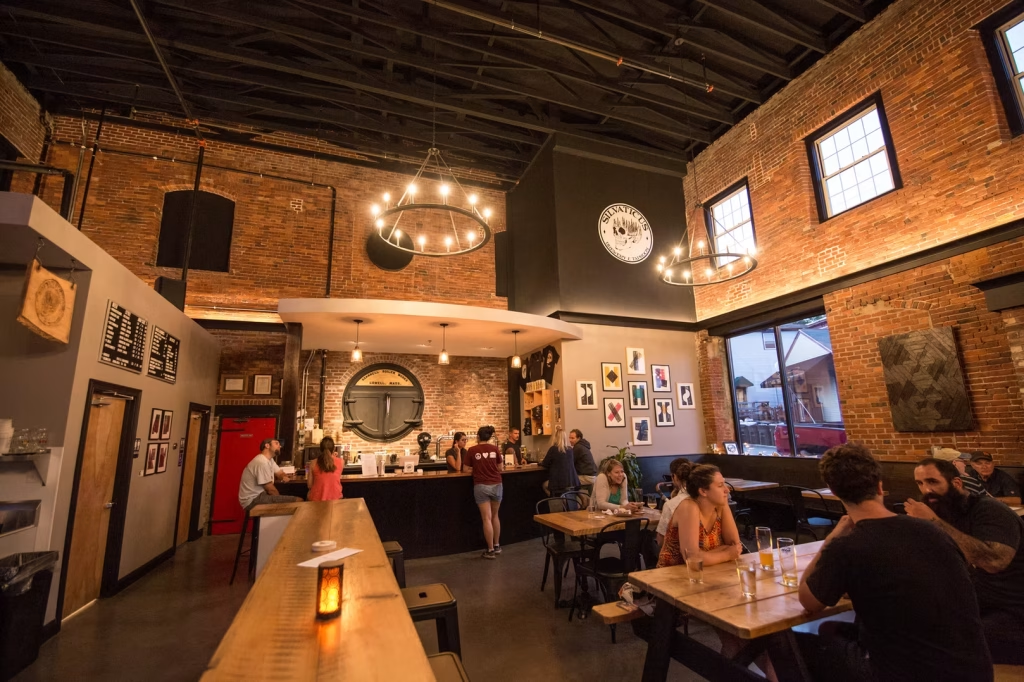
First, come visit our studio at 9 Water St! Then grab a beer downstairs at Brewery Silvaticus, or walk a little further to Barewolf Brewery. After you’ve had a few pints, visit Mel’s Record Store and shop irresponsibly, after which you can question your choices over coffee at Market Square Bakehouse. Once you’ve made peace with yourself, have a meal at Amesbury Flatbread or Nunami Thai Bistro. If it’s summer, you can visit Cider Hill Farm to pick your own fruit.

Harsh Realm has a distinct energy to it. Where does that aesthetic come from? Music, subculture, youth scenes, something else?
This is going to be my longest answer, so stay with me.
Definitely music and the punk/indie subculture. I grew up on early 90s alternative rock and the 80s punk and post-punk that influenced it, and that strain of subversive, sardonic angst is hardwired into my DNA. The same music scenes also produced incredible graphic design and art, so the two are inextricably linked in my mind.
The name Harsh Realm actually comes from an interview Megan Jasper gave to the New York Times in 1992 for an article about grunge. They wanted to know if there was any hip Seattle lingo kicking around, so she made up a list of nonsense that they printed without question. “Harsh realm” translates to “bummer.” The Times was not happy when they realised they’d been bullshitted, and I’ve never outgrown that attitude.
The band that influences my printmaking most directly is Godspeed You! Black Emperor. Their whole vibe matches the feeling I’m often trying to articulate: decay, bewilderment, sadness, and a stubborn strain of optimism.
There’s the world as it is and the world as we wish it was, and, equally, there’s a factual past and a nostalgic past. This tension is barely hidden under the surface here in America, and maybe not hidden at all. A substantial subsection of our country insists on lying about our history.
This manifests in very obvious ways, but also in subtle, insidious visual cues we experience every day. Take urban “historic preservation,” for example. Preservation efforts aim to freeze a city or neighbourhood at what is deemed to be its most appealing or “important” time period. It’s a deliberate choice rooted in nostalgia as much as history, and designed to frame history from a specific (usually White) point of view.
There’s a great book by Daniela Sandler that coins the term “counterpreservation” and then examines how this theory has played out in Berlin. Counterpreservation embraces the layers of history to produce the fullest perspective of a place, sort of like observing strata in geology. Berlin, obviously, has been through quite a bit through the years, and what might be seen as “blight” in America has been embraced by Berliners as integral to the urban landscape and a vital cultural ingredient. There’s tension in Berlin too — just look at the Tacheles project or count the cranes rising above the city — but historically, people there live within and alongside their history instead of trying to hide it.
It’s no stretch to say that this tension applies to people as well, to our memories and the stories we tell ourselves about ourselves. We all have “blight” in our personal histories that makes us uncomfortable. A lot of my work is an experiment in disassembling this tension and confronting it. It’s a very personal experiment but I think a lot of people feel this tension too, even if they can’t quite name it.


What role does community play in your creative life? Do you collaborate locally, or is it more solitary?
Setting all the heady stuff aside, my goal for Harsh Realm is to be a vital member of our community. Silkscreen is a very approachable medium and lends itself perfectly to in-person demos and activities. I’ve done print-your-own events at our Open Studios and a few other local events and people LOVE pulling their own print or T-shirt. I’ve also sold prints to raise money for trans youth and other causes I care about.
I’m very solitary when it comes to my work, however. Margaret is a great sounding board, but my process is fairly private and internal.
Are there local designers, printers, musicians or artists you feel connected to right now?
Yes! There’s a wide range of artists and craftspeople in our area. Our studio is full of talented artists and craftpeople. Everyone is super supportive and serious about their work. We also have a cool local clothing brand, the Plum Island Museum of Lost Toys and Curiosities, and a fine art metal works. Not bad for a small town.
Outside Amesbury, I have deep admiration for Jes and Dan at Landland, who are probably most responsible for sparking my interest in screenprinting; I really love Dylan Bakker’s work and everything else at Many Tentacles in Berlin; and I adore Melissa and JW of Little Friends of Printmaking, who are just the nicest people you could ever meet.
When you think about style, whether clothing, interiors or printed matter, what feels timeless where you are and what feels fleeting?
This is potentially a cringey answer, but authenticity never goes out of style. It transcends fads and mediums and eras. I think people can tell when someone is trying to mimic or replicate work that’s been done before. The absence of soul is palpable. That doesn’t mean you can’t have success that way and plenty of people have. There’s an audience for the familiar and comfortable. But I think you end up with work that just sort of exists.
However, mimicry is an essential step on the way to finding your own identity. One of my all-time favourite bands was Cymbals Eat Guitars (RIP). Their first two albums were excellent, but you could clearly hear the influence of bands they loved. But then album three came out and bam — they had created something fresh, true, and really incredible. That’s a top-five album for me that I’ll listen to for the rest of my life.
I’m very much in that earlier phase myself, and that’s ok. Creativity is a continuum that builds upon itself. I think the fun part is pushing past the familiar and toward something that feels true, even if you’re the only person who likes it [laughs nervously].

Does the climate where you live affect your work? Light, seasons, mood?
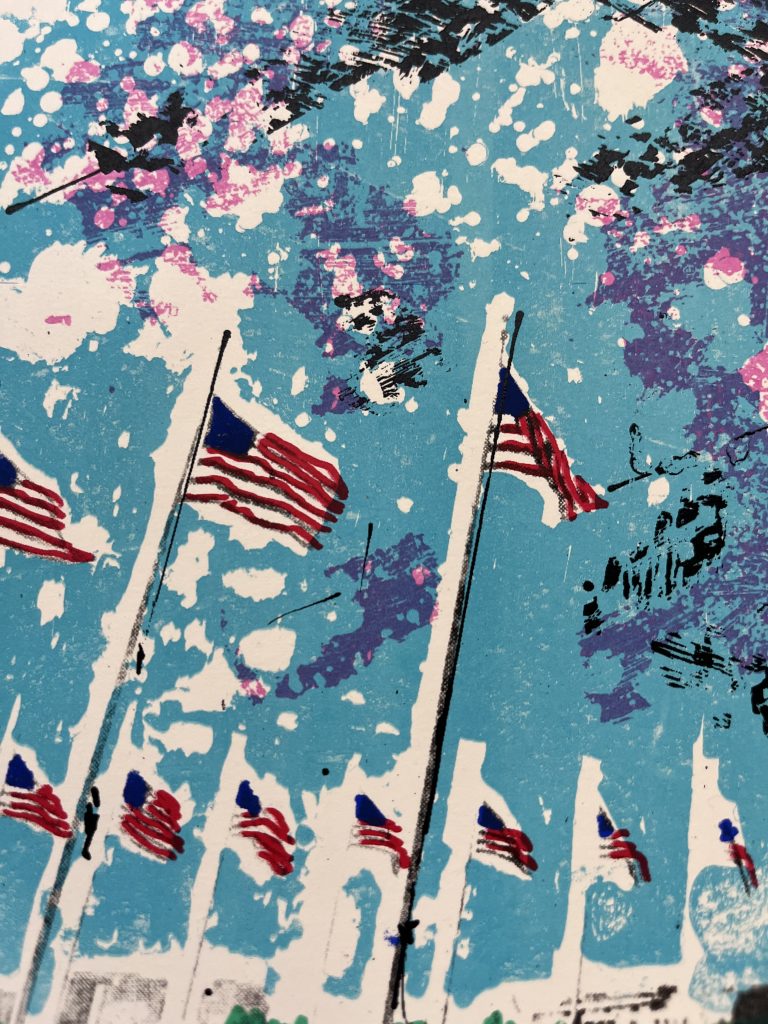
Probably! We have very distinct seasons here so the landscape changes drastically throughout the year. Right now I have two feet of snow in my yard, but you can feel spring creeping into the air. I’ve never lived somewhere without seasons and don’t think I’d like it. It sounds dull and numbing.
I don’t know if this affects my work directly, but I think the change of seasons and light keeps me tuned in to the world. Around this time of year, I start looking for buds on trees and other little changes in the environment. That first snow is always exciting. Maybe this keeps my creative mind sharp, or maybe it’s simply a distraction from The Horrors. Either way, I’ll never live in Florida.
What does success look like where you are? Is it commercial, cultural, underground, independent?
I run my studio like an old-school indie record label. My work is very much about my point of view, so I don’t expect it to have broad commercial appeal. But I would like to find an audience that gets what I’m doing and is interested enough to follow along. Right now, my financial goals are simply to break even. The truth is that I’m still learning and developing my skills, so there’s a way to go before this turns into something real. And that’s fine.
Ultimately, I really just want to be a part of our community. I want to hold more events and classes and contribute to all the positive energy we’re building in our town.
What does your wardrobe say about you as a designer?
It says my fashion sensibilities plateaued in 2003?
I’m very predictable: Black on black on black most of the time. It says “I don’t care,” but of course I care a little.

Finally, what advice would you give someone trying to build a creative life that blends corporate creative work with independent analogue practice?
Any corporate job, creative or otherwise, can feel like an obstacle to your independent work. The painter Walker Noble talked about this dynamic at Adobe MAX in 2023. He struggled for years to balance his corporate job with his creative pursuits until (if I remember correctly) his wife said, “Why don’t you think of your job as the ‘corporate sponsor’ for your painting?
Permit me a rant: Capitalism is a deeply broken system and I wish we could scrap it and start over. I don’t need to enumerate its faults here; it is inhumane by design. I’m a big fan of Carl Sagan, and I think a lot about his famous “pale blue dot” passage, which underscores what a preposterous species we are. Wealth? War? Status? Come on.
But until capitalism flames out, we need to work the system to our advantage. That “corporate sponsor” lens really clicked for me because it reduces the concept of a job to its purest capitalist form: I give you inputs (time, skills, and mental capacity) and you give me outputs (a salary and health insurance). I can use those outputs however I want, so I allocate some of them to support my creative work.
Having a corporate creative role is a blessing and a burden. On one hand, you get to make things all day and work with other creative people. On the other hand, being a creative in a corporate environment usually requires a lot of compromises. And PowerPoints. Oh god, the PowerPoints.
I think it’s important to recognise that using your creative skills and passion to earn a living is a real achievement. You’ve likely worked hard and made significant sacrifices to reach that point. I still remember college professors (of all people!!!) telling me my English degree would be effectively worthless in “the real world.” A lot of creative-minded people have to push through that kind of scepticism and doubt along their journey. You owe it to yourself to be proud of what you accomplish. Celebrate it!
So: I’m by no means suggesting you shouldn’t care about your work or career, just that it’s important to compartmentalise and maintain a transactional perspective on your job. Use it to your advantage: Learn new skills, make connections, and convert those outputs into a creative life outside work that is yours and yours alone.

marcroy@peopleofprint.com
- The Virgil Reader Vol. 001: Virgil Abloh’s Legacy as an Open-Source Tool - March 10, 2026
- City Series #002: Amesbury, Massachusetts with Carl Unger of Harsh Realm and Monotype - March 9, 2026
- How Creatives Shut Off From Work - March 4, 2026