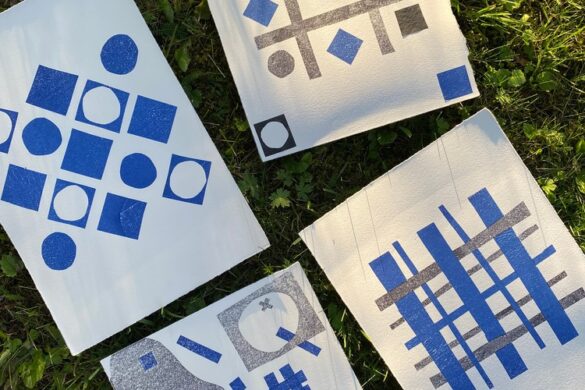

Deliberate/Deliberate, a joint exhibition at Graphic Studio Gallery in Dublin, brought together two printmakers whose practices share a commitment to process, restraint and the slow emergence of meaning through structure and deviation.
It can be rather calming, observing work that asks you to look slowly. Deliberate/Deliberate, which ran at Graphic Studio Gallery in Temple Bar from 31 January to 7 March, made that demand with confidence, presenting prints by Alastair Keady and Helen O’Sullivan that rewarded attentiveness and resisted any urge to glance and move on.
Keady’s work begins from a modular visual language of circles, squares and the points in between, shaped by a background in graphic design and a long affinity with the utopian underpinnings of late-period modernism. Composition, tone and colour function as communicative tools, building narratives that operate somewhere between the overt and the subliminal.
Working primarily in screenprint, he maintains a deliberately restrained set of elements while keeping the process genuinely open: accident, variation and shifts in intent are not disruptions to be corrected but integral parts of how the work develops. In recent pieces, text enters the practice as a structuring device and point of departure, with layered linguistic and sign systems engaging ideas of easter eggs, puzzles and messages hidden in plain sight.

One of the standout works, Specimen, draws on a letter of complaint about Brendan Behan, written by the keeper of St John’s Point Lighthouse in Co Down after Behan’s summer contract to whitewash Irish Lights properties in 1950.
“The letter is unintentionally hilarious,” Keady explains, “being a matter of great seriousness, and frustration to the lighthouse keeper, but painting a vista of a clash of personality, religion, politics, and sense of duty.”
That the outcome failed to satisfy its author, given that Behan was offered a second summer’s work the following year, gives the whole thing its absurdist charge. Keady uses it as raw material for screenprint and gild on wood panels across a surface measuring over two metres wide, the bureaucratic and the comic held together in a single large field.

Where Keady’s work hides things in plain sight, O’Sullivan’s practice arrives through quieter means. Her prints are built from disciplined sequences of mark-making, shaped by repetition, rhythm and restraint, and underpinned by a minimalist sensibility in which each gesture functions as an intentional pause. Working primarily with mokuhanga, the water-based woodblock process, and acrylic ink on washi, she pays equal attention to time and materials. The resulting work does not depict an image so much as create a condition: one of clarity, quietude and focused looking. Repetition and silence open a contemplative space rather than filling it.
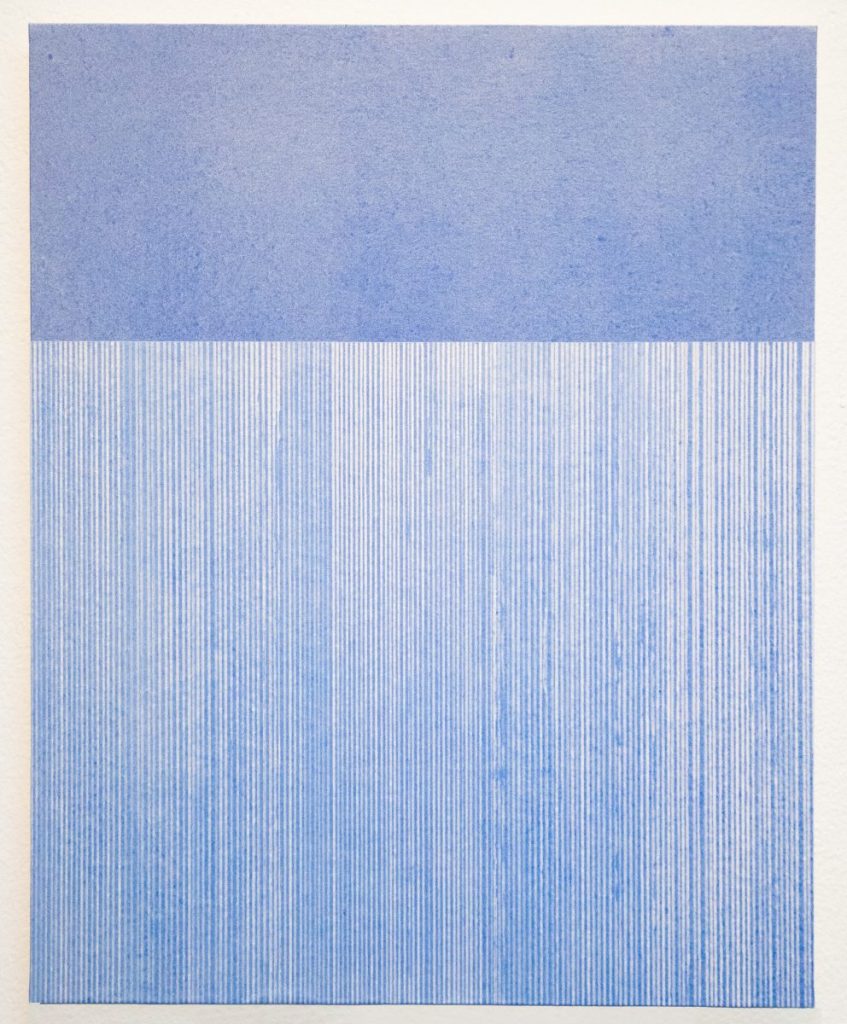
Together, the two practices found genuine common ground in their commitment to process as reflection, to making as a cultivated sensibility, and to the idea that meaning can emerge slowly through structure and deviation rather than declaration.
Alastair Keady is a graphic design graduate of NCAD and the Royal College of Art. He makes prints out of the Graphic Studio Dublin, hand-printed in small editions or occasionally as one-offs.
ARTIST LINKS
but-is-it.art
@alastairkeady
Deliberate/Deliberate, Graphic Studio Gallery, Temple Bar, Dublin. 31 January to 7 March. Works include: Tri-line 1, screen print and lenticular print on wood panels, 450 x 150mm (photo: @verarouu); Specimen, screen print and gild on wood panels, 2100 x 1200mm (photo: Alastair Keady); Polari 4, screen print, spray paint and gild on artists wood panels, 1200 x 1200mm (photo: Alastair Keady); Meditations: The Stars Began To Burn Through The Sheets of Clouds, 700 x 700mm (photo: @verarouu); Meditations: This Rain II, 300 x 300mm (photo: @verarouu). Helen O’Sullivan’s work photographed by @verarouu.


Want to know more about our membership? Give us an email at members@peopleofprint.com.
- The Body Knows the Ritual: Haviva Seligson’s Shofar - April 3, 2026
- What the Music Feels Like: Yeara Chaham’s Collage Response to Sade - April 3, 2026
- Kichizi: Aysha Lilani Brings East African Visual Language to the Slopes - April 1, 2026