
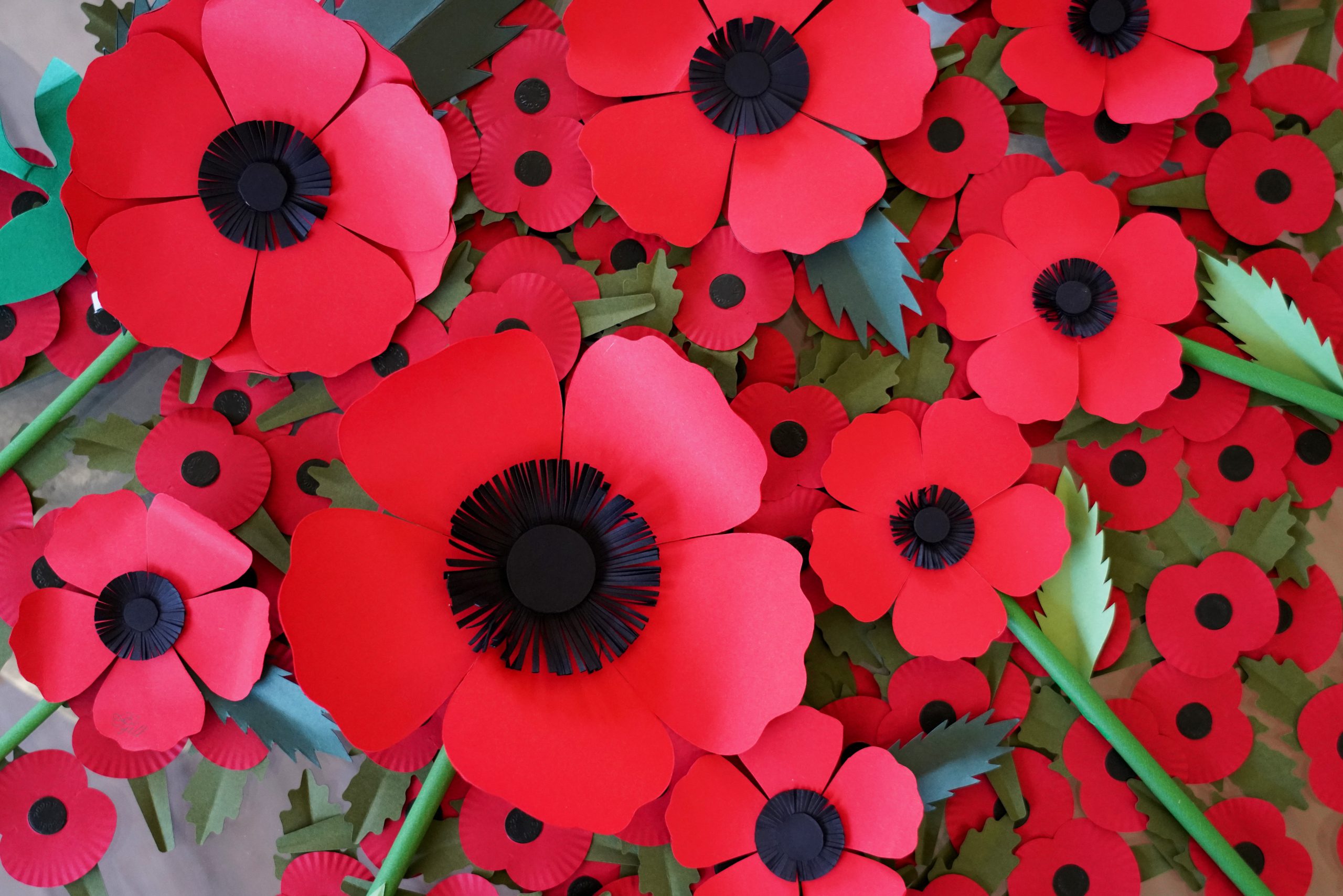

To mark Remembrance Sunday, James Cropper collaborated with two paper artists, Helen Musselwhite and Sarah-Louise Matthews, on a pair of projects that explore what paper can do when it carries emotional weight. Both works are rooted in the same red paper James Cropper has been making for the Royal British Legion for more than 40 years.
Helen Musselwhite has been making things from paper for about 20 years. It started, she says, with a large tracing paper angel made for a Christmas shop window, and she has never really stopped. Based on the southern edge of Manchester where the city gives way to the Cheshire countryside, her work is shaped almost entirely by the natural world: layered flora and fauna scenes built from cut, scored and curled paper, often working in the tones of a single hue, gradually introducing colour until a piece finds its own depth. Her father’s family worked the land as farm labourers, shepherds and thatchers, and she describes that connection to the British countryside as something close to instinct. “As you’ll gather from my work,” she has written, “a lot of inspiration comes from the British countryside.”


That sensibility made her a natural fit for the James Cropper commission. For the project, Musselwhite worked with James Cropper paper, which she praised for its saturated colours and ease of manipulation, to create an artistic interpretation of the plastic-free poppy, alongside a community initiative that invited as many people as possible to make their own version. Local schools, customers and James Cropper employees all took part, and the resulting creations were displayed in the mill’s main reception area from 10 November to commemorate the bravery of the armed forces.
Yorkshire-based paper engineer Sarah-Louise Matthews approaches the material from a different direction. Where Musselwhite builds in layers, Matthews works through cutting, folding, pleating, slotting and interlocking, constructing new surfaces and three-dimensional forms from paper’s structural possibilities. Her work draws on geometric and botanical patterns, and she brings what has been described as a child-like approach to elegant and considered results: restrained in palette, precise in line, instantly recognisable to anyone who follows the craft closely. She has worked with brands and individual clients across paper cut decorations, stationery and bespoke artworks.

James Cropper commissioned Matthews to create a three-foot interpretation of the new plastic-free poppy, installed at the entrance to the Burneside mill to mark its unveiling. It is a striking choice of scale: a poppy most people know as something small enough to pin to a lapel, reimagined at a size that asks you to stop and look at it properly.


The paper those poppies are made from has its own history. James Cropper has supplied the red and green paper for the Royal British Legion’s Poppy Appeal since 1978, when the Legion asked the Burneside mill to develop a colour-fast, biodegradable alternative to the original fabric poppy. The challenge was specific: the paper had to hold its crimson in rain and cold without the dye rubbing off onto clothing. The mill solved it, and has supplied over 5km of narrow paper rolls to the RBL and Poppyscotland poppy factories every year since. In 2023, that partnership produced something new: the first entirely plastic-free poppy, made using a blend of renewable fibres, half of them recovered from paper coffee cups through James Cropper’s CupCycling facility in Cumbria, and independently verified to cut carbon emissions by 40 per cent against its predecessor.
The poppy has been worn as a symbol of remembrance since 1921.
🌐 jamescropper.com 📷 @jamescroppercreates
About James Cropper
James Cropper is a specialist paper manufacturer based in Burneside, near Kendal in Cumbria, with a history stretching back to 1845. Known for its expertise in coloured and technical papers, the mill works with luxury brands, packaging clients and creative industries worldwide. Its CupCycling facility recovers fibre from used paper coffee cups for use in new paper production, and the company holds a long-standing partnership with the Royal British Legion as the maker of the red paper used in the annual Poppy Appeal.


Popular posts