
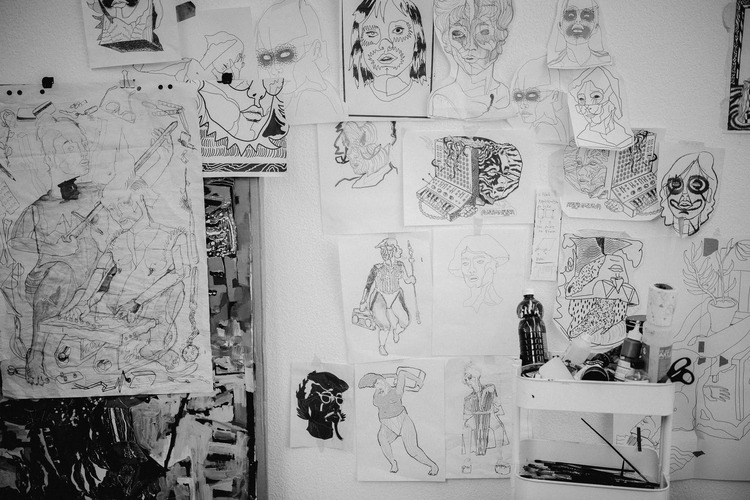
Carsten Wagner is a painter and printmaker living and working from Hamburg, Germany. “I see myself as an experimental printer and at least half of my inspiration comes from ‘the next technical variation'”, says the artist. His studio is home to his own printing press with a roller width of 100cm, where he can work spontaneously on new ideas and projects.
After focusing on painting canvases for many years, one day Carsten saw a two-colour linocut at a friend’s house and something clicked within him; “That must have been before the turn of the millennium and I haven’t let it go since,” comments the printmaker. With no formal training or studies in printmaking, Carsten believes it is his family that gave him the right attitude towards the craft (Carsten comes from a family of people who have been closely connected to printing and paper; his great-grandfather had a bookbinding business, and his father was one of the last master typesetters in the region), with the internet doing the rest. For many years, he worked in isolation, discovering and following along with other printmakers online, sharing knowledge through videos. However, he has now gone on to have met some great, helpful people, with the future hope of exhibiting more and collaborating with others.
 Carsten tells us; “I have limited patience and many of my work processes originated from the need to work more directly or to be able to see a result more quickly.” Thus, he also likes to work with stencils in linocut printing. Inspired by the work of Séamus Fegan who uses paper as a printing block, Carsten decided that instead of cutting a lino plate, which is time-consuming, he would cover areas that should remain white with paper stencils. “This is much quicker and I can use the linoleum again and again for other projects”.
His stencil works begin with a drawing or a painted picture on printing paper. To create the stencils, Carsten transfers the relevant areas to another piece of paper. Once the stencil is cut out, he usually attaches it to the printing paper, using washi tape over the areas that are not to be printed. There are many ways to influence the structure of the print result; for example, Carsten likes to use yarn, thin wires, garbage bags, and leaves, creating results that are always unique.
Before printing, he sprays the back of the printing paper with water so that the colour absorption is better. Sometimes it is easier to stick the coloured linoleum plate onto the paper, sometimes the other way around. In any case, after printing, he waits until the water has evaporated before attempting to remove the washi tape and the stencil.
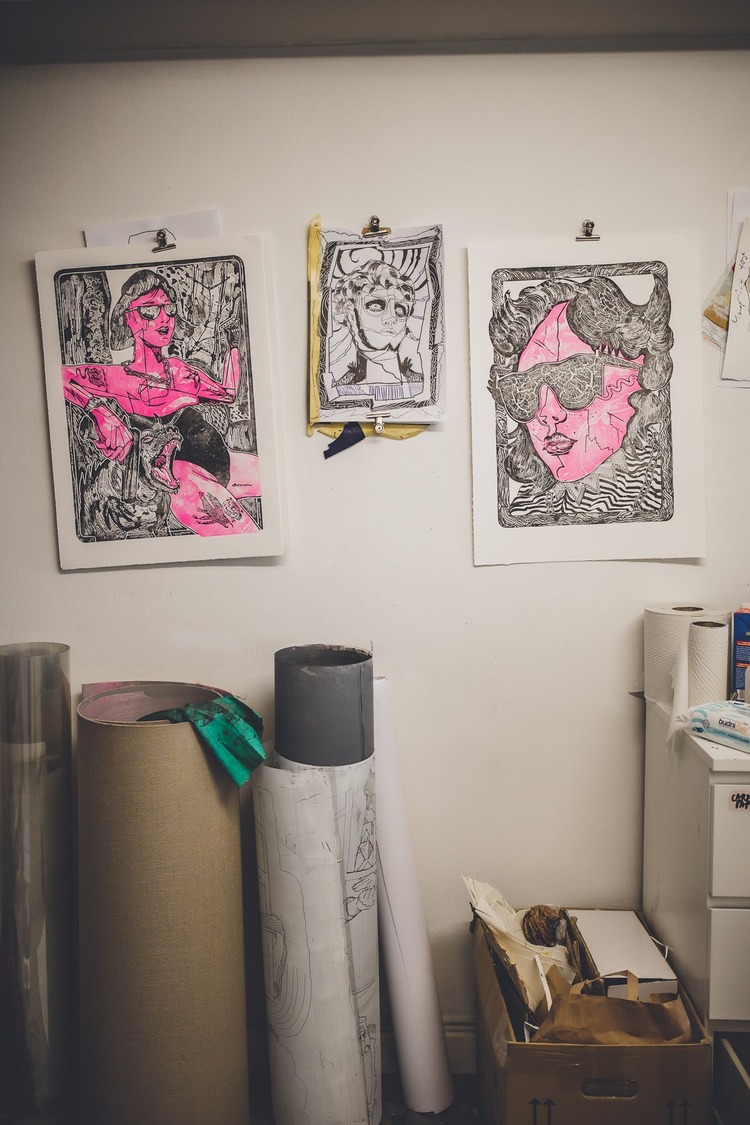
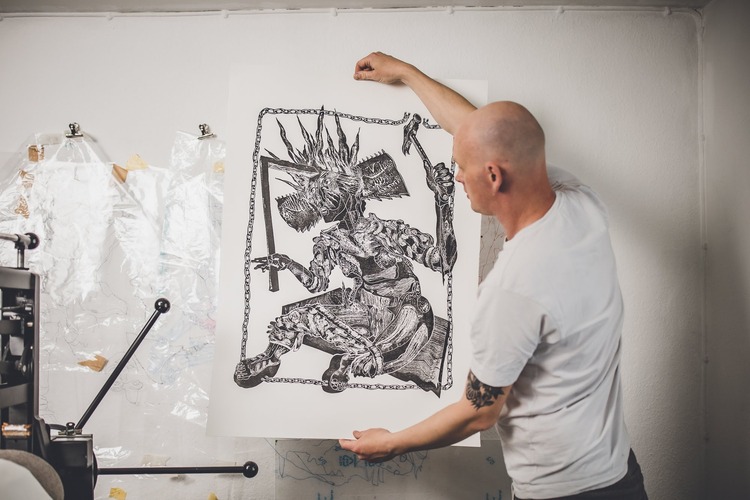
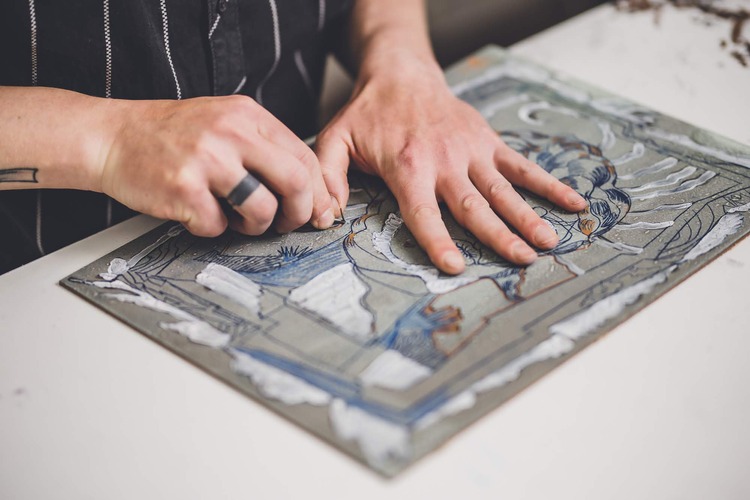
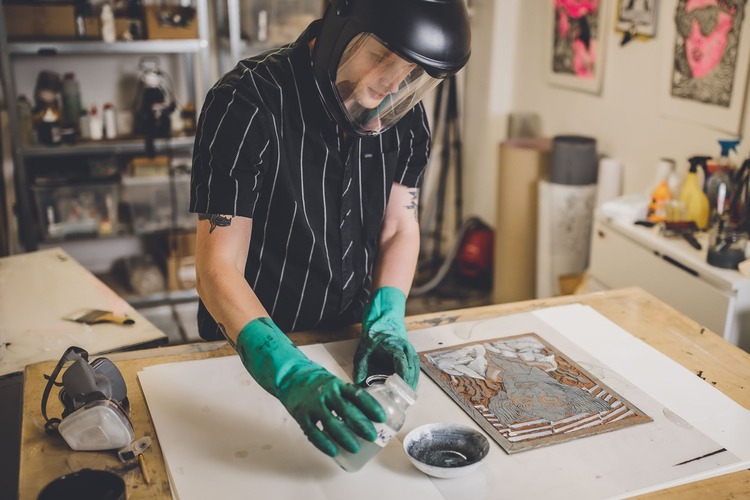
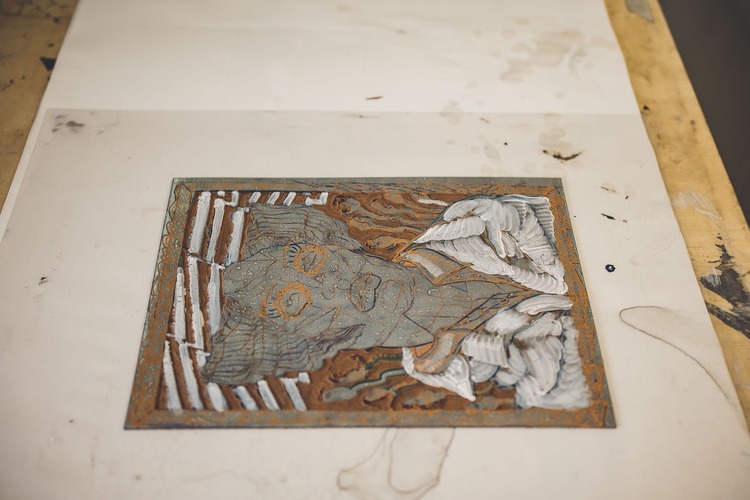
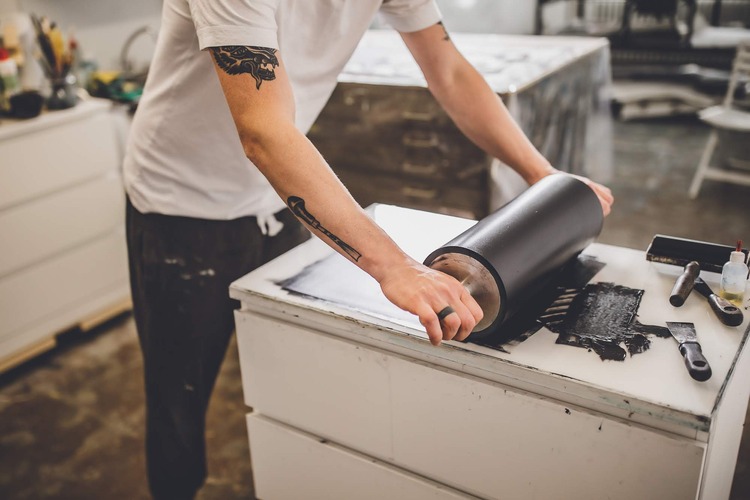 Over the last 10 years, Carsten has also developed his greatest passion for etched lino prints. After discovering the work of Steve Edwards and Aine Scannell online, Carsten’s path was set. For this printmaking method, he prefers to work with a sketch which he then transfers to the lino block using carbon paper. He explains; “I have gotten into the habit of doing most of the carving work before etching, as a large part of the sketch on the lino block is lost during this step”. After carving, he then prepares the block for etching, applying Lascaux hard resist or wax paint to protect certain areas. As the hard resist is transparent, he also mixes in a drop of acrylic paint (as opposed to the printing ink). Carsten uses applicator bottles (nail studio) for thin lines, crackle medium or coarse sponges for structures, or drypoint to work on the hard resist after it has dried. Then he gets etching. After an hour, the plate is rinsed with plenty of water and brushed off properly. Hard resist residue that has not been removed can later stick to the ink roller when inking the plate, so after brushing he goes over the linoleum plate again lightly with a paint spatula. When the plate is dry, he prints as usual.
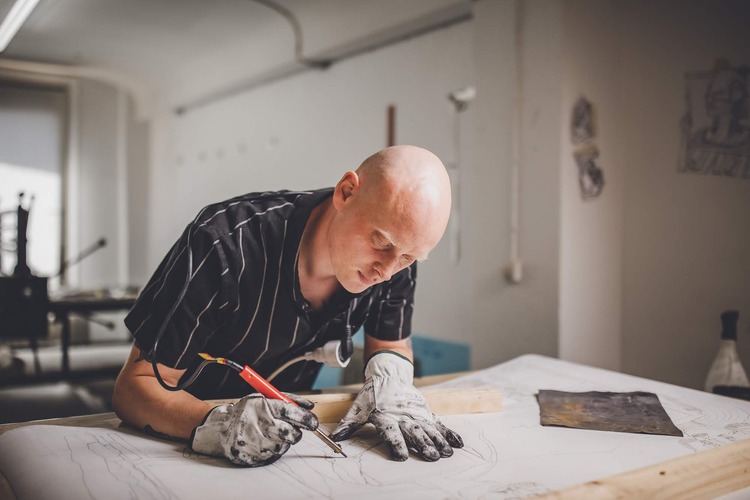
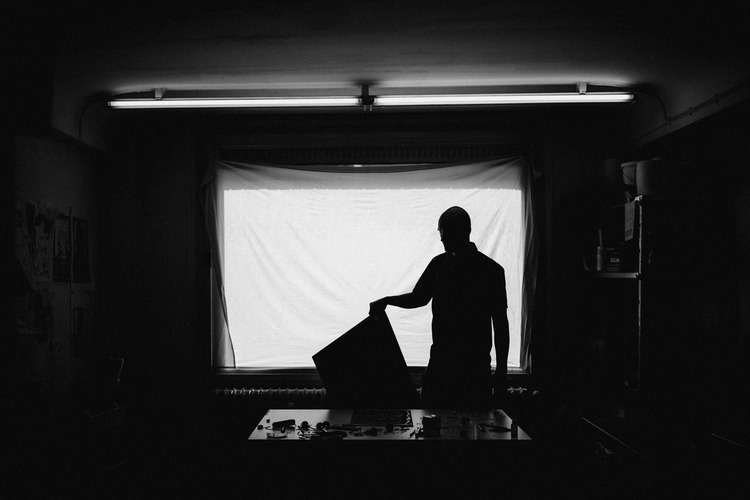
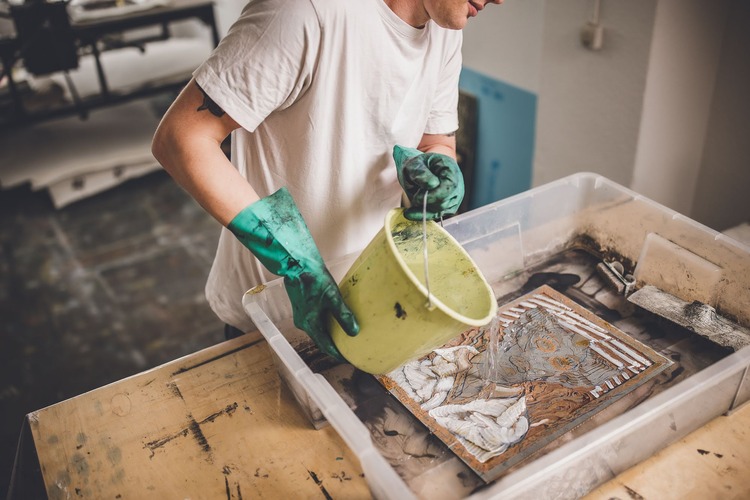
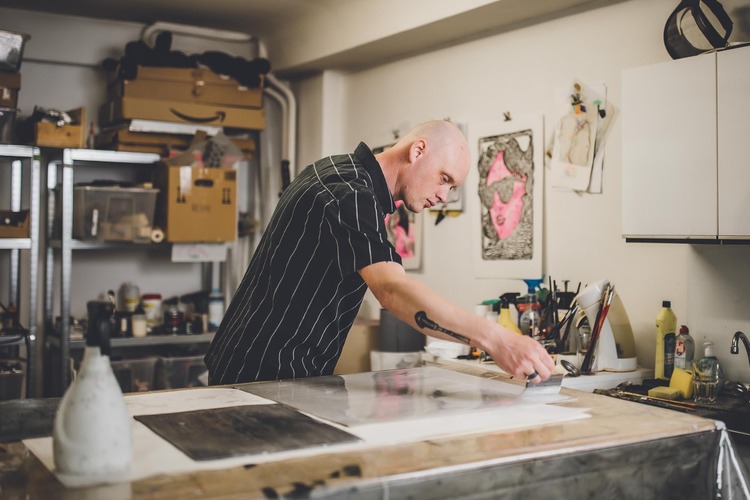 Carsten also works with PCB dry film Intaglio. When working on sketches for his designs, he often doesn’t know which technique he will go on to use. When working with intaglio, he often had difficulties transferring the sketch later. Thus, he quickly started applying photopolymer to copper and zinc plates so that he could expose sketches directly onto the plates. After purchasing PCB circuits on the internet (it is sold on rolls, well sealed, and consists of a bluish solid gel between two films) Carsten heads to the dark room where he works under yellow light (at a distance of about 2 meters from the light source). Once the metal plate is degreased, he removes the inner film of the dry film. Since water is needed to connect it to the metal plate, Carsten puts the metal plate in a bowl of water and places the dry film with the exposed side facing down on the plate in the water bath. When he now lifts the metal plate out, the dry film stays on this layer and can be easily moved back and forth until the desired position is reached. He then wipes off any excess water to the side, and turns the plate over and removes excess film with a knife. Carsten then runs the plate with the film through a laminator once or twice, and next leaves the plate wrapped up and in a dark drawer to dry for a day. After that, exposure can take place in a similar way to screen printing. Carsten uses a water bath with pure soda to wash it out, and can then print the plate directly or etch it using various methods.
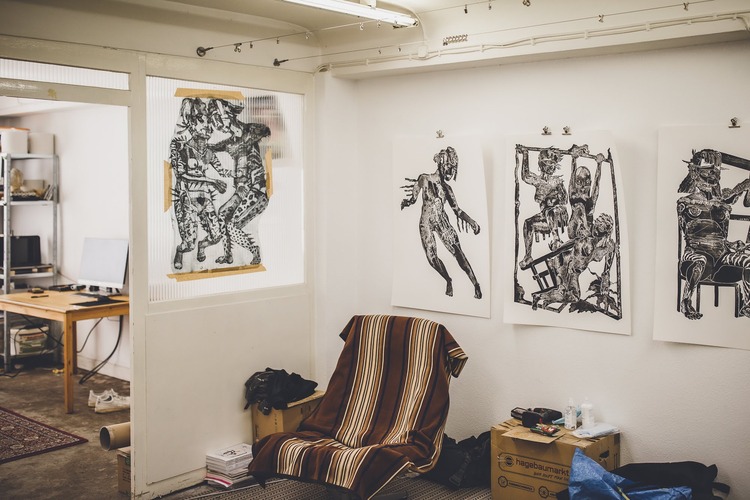 Carsten’s main source of inspiration for his creations comes from his passion for experimentation and his playful exploration of printmaking technique. Events from his own life and memories of youth also offer inspiration for his designs. However, there are also a lot of external influences on his works. He comments; “For example, if I see some interesting way of printing on the internet from another artist, it gets something working in me. It’s a bit like when you watch a cooking show and then want to try cooking spaghetti bolognese in your own way. Every family does it a little differently.”
Currently, Carsten is finishing an exhibition, and is looking forward to heading back to his studio and forging new experiments, collaborations, and future shows.
Photography by Gregor Borwig.
Want to know more about our membership? Give us an email at members@peopleofprint.com.